Best Wine Fridges
Budget picks · Countertop wine coolers

The best small wine fridges under $200.

Under $200 you are not choosing between good and better. You are choosing which compromise you can live with — and one of the seven units below makes a compromise most buyers regret by August.

By Ilane Tall · Updated August 13, 2026 · Research-based.

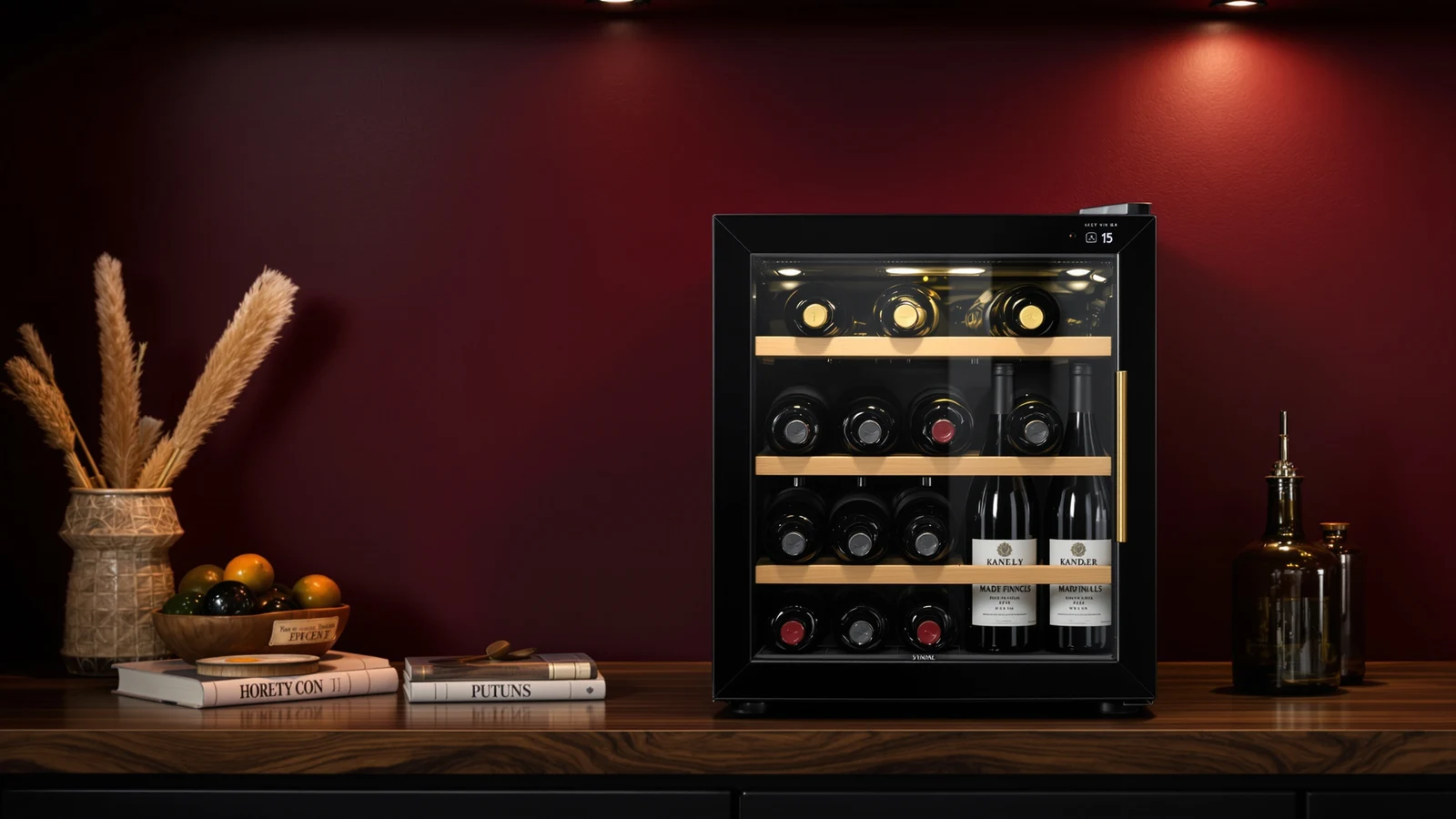
Small countertop wine fridge with a glass door holding a handful of bottles, on a kitchen counter

A wine fridge under $200 is a specific object with specific limits, and almost none of the marketing around it says so plainly. It is small: four to fourteen real bottles, not the number on the box. It is single-zone, whatever the listing implies. It will not age anything — it holds wine at a drinkable, stable temperature, which is a genuinely useful thing and a completely different thing from cellaring. And in this price band the single decision that determines whether it works at all is one most buyers never make consciously: compressor or thermoelectric.

We read the specifications and the current prices for the small wine coolers listed in the US under $200, cross-checked them against the pattern in owner reports, and cut the list to seven units that are worth someone's money for a clearly stated reason. Two of them are only worth it under conditions we will spell out. One of them is the answer for most people, and it is not the most expensive one here.

Reader-supported. We may earn a commission if you buy through the links on this page, at no extra cost to you. Prices shown were correct at the time of writing and move often — confirm the current price on Amazon before you buy.

At a glance

The seven, compared

Capacities are the manufacturer's figures and assume slim Bordeaux bottles. The realistic number in brackets is roughly 75% of that — see why below.

ModelBest forCapacityCoolingLockPriceGet it
ROVSUN 18 Bottle Compressor Best under $200 overall 18 bottles (plan on ~13) Compressor No $159.99 Get it
Winado 12 Bottle Compressor Cheapest real compressor 12 bottles (plan on ~9) Compressor No $129.99 Get it
BLACK+DECKER BD60336 12-Bottle Narrowest footprint 12 bottles (plan on ~9) Thermoelectric No $185.99 Get it
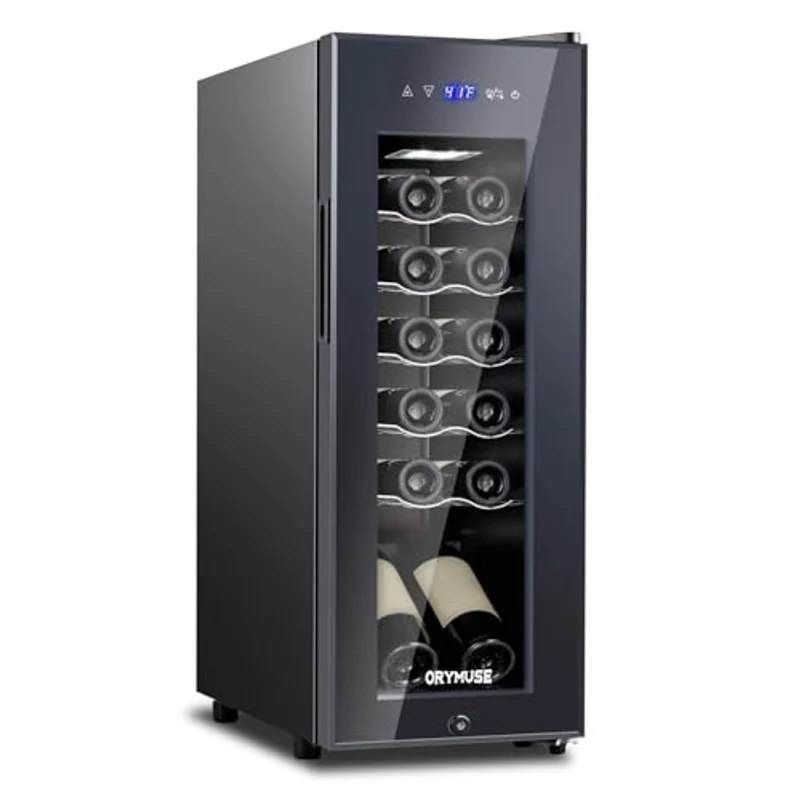
ORYMUSE 12 Bottle with Lock The one with a key 12 bottles (plan on ~9) Compressor Yes $179.99 Get it
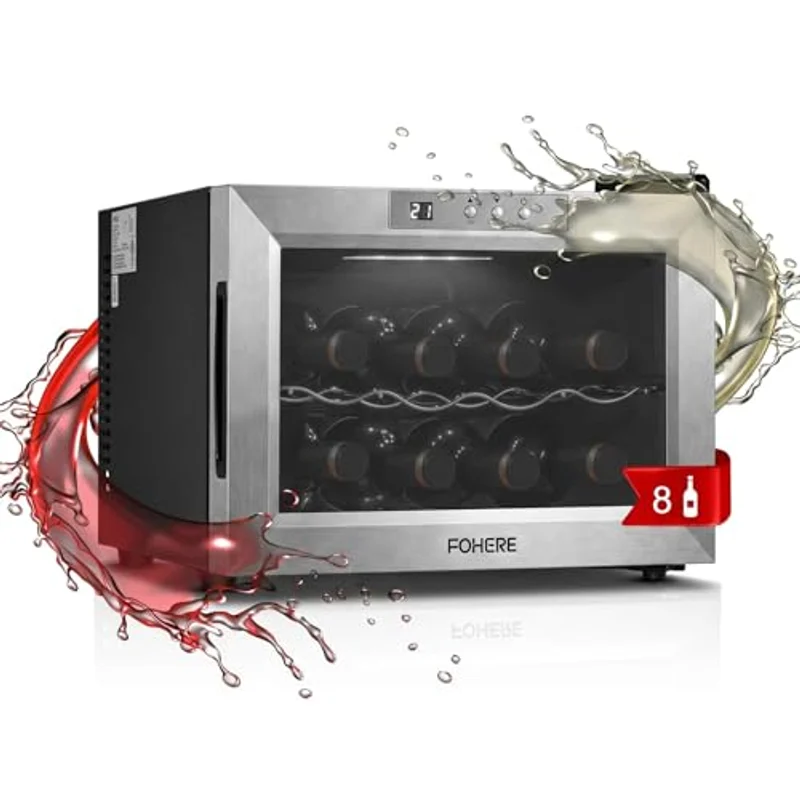
FOHERE 8 Bottle Double-Door The one that looks the part 8 bottles (plan on ~6) Thermoelectric* No $139.99 Get it
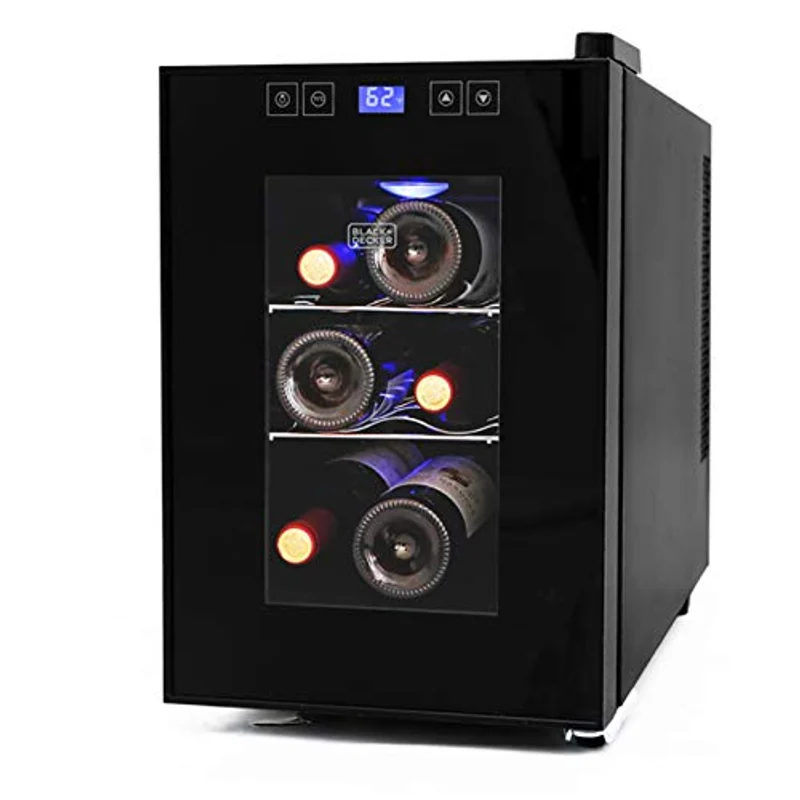
BLACK+DECKER BD60016 6-Bottle Smallest name-brand unit 6 bottles (plan on ~4) Thermoelectric No $129.99 Get it
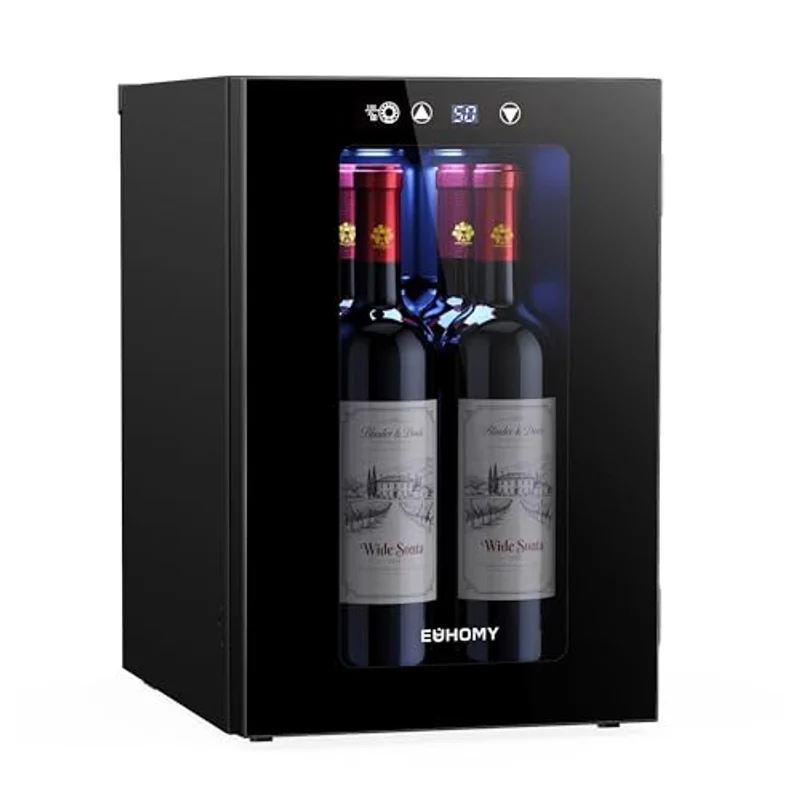
EUHOMY 18L Mini Wine Fridge The cheapest way in 18 litres (~6 bottles) Thermoelectric* No $111.99 Get it

* The EUHOMY and FOHERE listings do not state the cooling method in plain language. At this size, weight and price, the sensible assumption is thermoelectric — and the sensible way to buy is to plan for thermoelectric behaviour and treat a compressor as a bonus. Every unit here is freestanding. None of them may be built into a cabinet run.

The decision that matters

Compressor or thermoelectric, at $130

Thermoelectric cooling has no compressor and no refrigerant. It moves heat across a solid-state plate, and it can only move so much of it — in practice about 20°F below whatever the surrounding room is doing. That is the whole specification, and everything about how one of these units behaves follows from it.

Do the arithmetic for a real American kitchen. A room sitting at 72°F gives a thermoelectric unit a floor of roughly 52°F. Comfortable: it will hold 55°F all day. Now put the same unit in the same kitchen in August, when the room drifts to 82°F in the afternoon because the oven has been on and the air conditioning is fighting a losing battle. The floor moves to 62°F. The display may still read 55, because the display reads the setpoint, not the reality. The wine inside is now sitting at cellar-plus-seven, and the owner reviews that say it never gets cold enough are almost always describing this and not a defective unit.

The most useful sentence in this article

If the room ever gets warm, the $129.99 Winado compressor unit is a better wine fridge than the $185.99 BLACK+DECKER thermoelectric — by $56 and by a wide margin on the only job that counts.

Price is not the ranking in this category. Cooling method is.

A compressor unit does not care what the room is doing within reason. It runs a real refrigeration cycle, so it holds its setpoint in a 78°F kitchen the same way it holds it in a 68°F study. What you pay for that is noise and vibration: an intermittent hum when the compressor cycles, and a faint buzz through the countertop. In a kitchen nobody notices. Three feet from a pillow, some people notice a great deal.

So the honest decision tree is short. If the unit is going in a bedroom, a nursery, a small home office or anywhere silence is the point and the room is climate-controlled year round, thermoelectric is a deliberate, defensible choice. If it is going in a kitchen, a dining room, a converted garage, a sunroom, an apartment without central air, or anywhere in Texas, Florida or Arizona, buy a compressor and accept the hum. We work through the full trade-off in thermoelectric vs compressor wine coolers.

One more consequence worth knowing: thermoelectric units cannot be pushed. If yours is not reaching temperature, the fix is almost never the fridge — it is the room, the clearance behind it, or direct sun on the glass. That is also the first thing to check before assuming a unit has failed, which is the subject of our troubleshooting guide.

Read the box sceptically

The bottle count on the box is not the bottle count

Every capacity rating in this category is calculated with a slim Bordeaux bottle: straight sides, narrow shoulder, 750ml, stacked in a perfect grid with nothing standing up and nothing half-drunk. Real wine racks do not look like that. Burgundy and Pinot Noir bottles are noticeably wider. Champagne and sparkling bottles are wider still and heavier. A single Pinot bottle on a wire shelf can cost you the slot next to it, because the shelf spacing was cut to the millimetre for Bordeaux.

Across the category, 70–80% of the advertised figure is the honest planning number. On a 28-bottle unit that rounding is an irritation. On a 6-bottle unit it is the difference between a wine fridge and a decoration: a “6-bottle” cooler holding four Burgundies is doing about two thirds of the job you paid for, and there is no shelf you can remove to get it back.

That is why capacity per dollar matters more at the bottom of the market than anywhere else. Run the numbers on the seven units here, using the advertised counts, and the spread is enormous:

  • ROVSUN 18 bottle, $159.99 — about $8.90 a bottle slot, the best ratio on this page by a distance.
  • Winado 12 bottle, $129.99 — about $10.80 a slot.
  • ORYMUSE 12 bottle, $179.99 — about $15.00 a slot, with the lock accounting for most of the premium.
  • BLACK+DECKER BD60336 12 bottle, $185.99 — about $15.50 a slot, paid partly for the mirrored door and the narrow cabinet.
  • FOHERE 8 bottle, $139.99 — about $17.50 a slot.
  • EUHOMY 18L, $111.99 — roughly $18.70 a slot at six bottles.
  • BLACK+DECKER BD60016 6 bottle, $129.99 — about $21.70 a slot, the most expensive storage here.

None of that means the small units are bad buys. It means you should know what you are paying the premium for — a footprint, a brand, a mirrored door, a lock — rather than assuming the more expensive unit stores more wine. Twice out of seven here, it stores less than half as much.

Where the money went

What a manufacturer cuts to hit $150

None of these cuts are scandals. All of them are real, and knowing them in advance is the difference between a good cheap purchase and a disappointing one.

01

Chrome wire, not wood

Beech shelving damps vibration and looks like a cellar. Wire shelves are stamped steel: cheaper, thinner, and they leave a mark on the label of a bottle left standing for a year.

02

Single or double glazing

Expensive units use triple-glazed, UV-treated glass. Here you get single or double-layer glass, so more heat comes in and more light reaches the bottles.

03

A coarser thermostat

Some units in this band step in 2–3°F increments rather than one, and a few offer only a dial with numbered positions. Setting exactly 55°F may not be an option.

04

Thinner insulation

Less foam in the walls means the cabinet loses temperature faster during a power cut and recovers more slowly after the door is opened.

The list continues past those four. Under $200 you generally do not get a carbon filter, which matters only if you plan to store bottles for years and want the air scrubbed. You do not get a humidity system, so corks will dry slowly — irrelevant over eighteen months, relevant over ten years. You rarely get a lock; exactly one unit on this page has one. Fans are louder and cheaper, so on a quiet night a compressor unit in an open-plan apartment is audible. Interior LEDs are usually white rather than the amber lighting used in better cabinets, and white LED light left on continuously is not doing a bottle of rosé any favours. Leave the light off unless you are looking in.

The cut that costs the most money later is the warranty on the sealed system. Premium brands separate the cabinet warranty from the compressor and sealed-system warranty, often covering the latter for several years. At this price the whole appliance typically carries one year, full stop. Budget accordingly: a $130 wine fridge that lasts three years is a fine purchase; the same unit is a poor one if you were mentally amortising it over ten.

What you should not expect to be cut is basic temperature control, and this is the line worth holding. A compressor unit at $130 does the core job about as well as a compressor unit at $400 — it just does it for fewer bottles, more loudly, with worse shelves. That is a very different kind of compromise from a unit that cannot reach the temperature at all.

Do not get this wrong

All seven are freestanding — none may be built in

This matters more at $150 than at $600, not less. Every unit on this page rejects its heat out of the back and the sides. Slide one into a cabinet cut-out, or wedge it under a counter between two cabinet runs, and that heat has nowhere to go. The unit sits in a pocket of its own exhaust, the ambient temperature around it climbs, and both cooling technologies fail in their own way: a compressor runs continuously and wears out early, and a thermoelectric unit simply stops reaching temperature because its 20°F ceiling is now measured against a hot box rather than a room.

Only a model the manufacturer rates as built-in — which vents through a grille at the front — may be enclosed. That capability starts well above this price band. The full explanation, including how to identify a front-venting unit from a listing photo, is in built-in vs freestanding wine fridges.

Practically: leave two to four inches of clear air behind and above the unit, keep it out of direct sunlight, and do not put it beside an oven, a dishwasher or a radiator. On a countertop, check the cabinet overhang above it — a 20-inch-tall cooler under a shelf 21 inches up is technically freestanding and functionally boxed in.

The picks

Seven units, and exactly who each one is for

01Best under $200

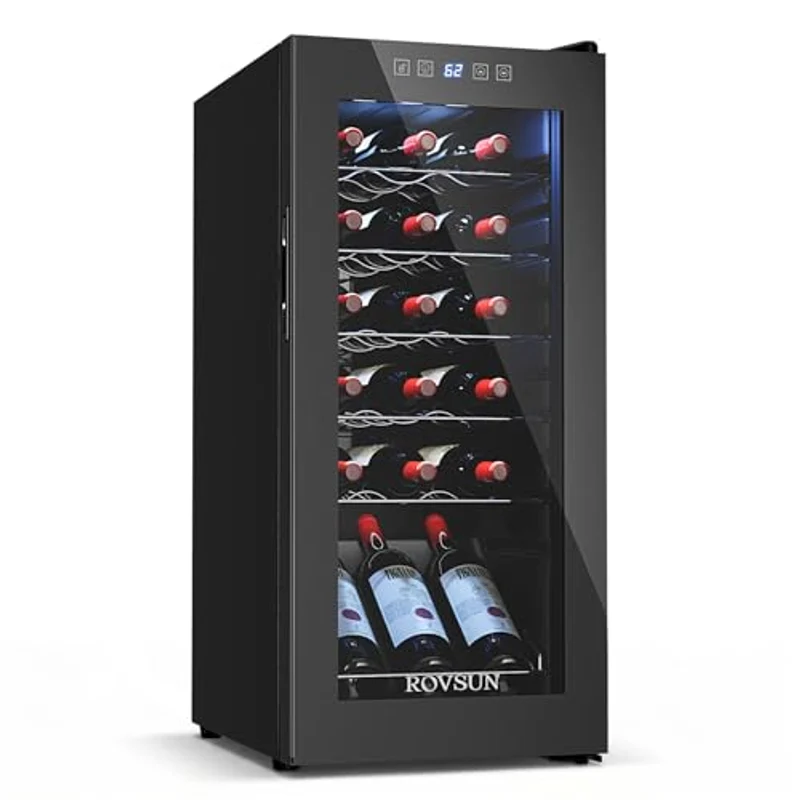
ROVSUN 18 Bottle Freestanding Compressor

Best for: the most wine, correctly cooled, for the least money

18 bottles·Compressor·Digital control·Freestanding

This is the unit that makes most of the others hard to justify. Real compressor cooling, so the room can do what it likes; digital temperature control rather than a numbered dial, so you can actually ask for a number; double-layer glass and chrome shelves. Eighteen advertised slots is more than any other unit here, and it is the cheapest storage on the page at roughly $8.90 a slot. Plan on about thirteen mixed-shape bottles in practice.

The honest downsides: the shelves are chrome wire, so labels can mark if bottles sit for years; the single zone means one temperature for reds and whites, which is fine at 55°F and a compromise if you want whites served cold from the cabinet; and there is a compressor hum you will hear in a quiet room. It is also the largest cabinet here, so measure before you commit to a countertop.

If you have not got a specific reason to buy something else on this page, buy this.

ROVSUN 18 Bottle Freestanding Compressor wine cooler
Price
$159.99
Check price →
02Cheapest real compressor

Winado 12 Bottle Compressor Wine Cooler

Best for: a warm room and the tightest budget

12 bottles·Compressor·Single zone·Freestanding

The cheapest way we found to get genuine refrigeration rather than a solid-state plate, and the pick that should end a lot of shopping trips. At $129.99 it costs the same as a six-bottle thermoelectric cabinet and less than every thermoelectric unit above it here, while doing the one thing those cannot: holding 55°F in a kitchen that hits the eighties. Twelve slots, about nine in practice, at roughly $10.80 a slot.

The honest downsides: Winado is a value brand, not a heritage one, and the build reflects the price — thin door trim, wire shelves, a basic control, and a one-year warranty on everything including the sealed system. It hums. Owner reports repeat the same two themes: the cooling is not the problem, and the finish is not luxurious. Both are what $130 buys.

The pick that quietly beats units costing $50 more.

Winado 12 Bottle Compressor Wine Cooler Refrigerator
Price
$129.99
Check price →
03Narrowest footprint

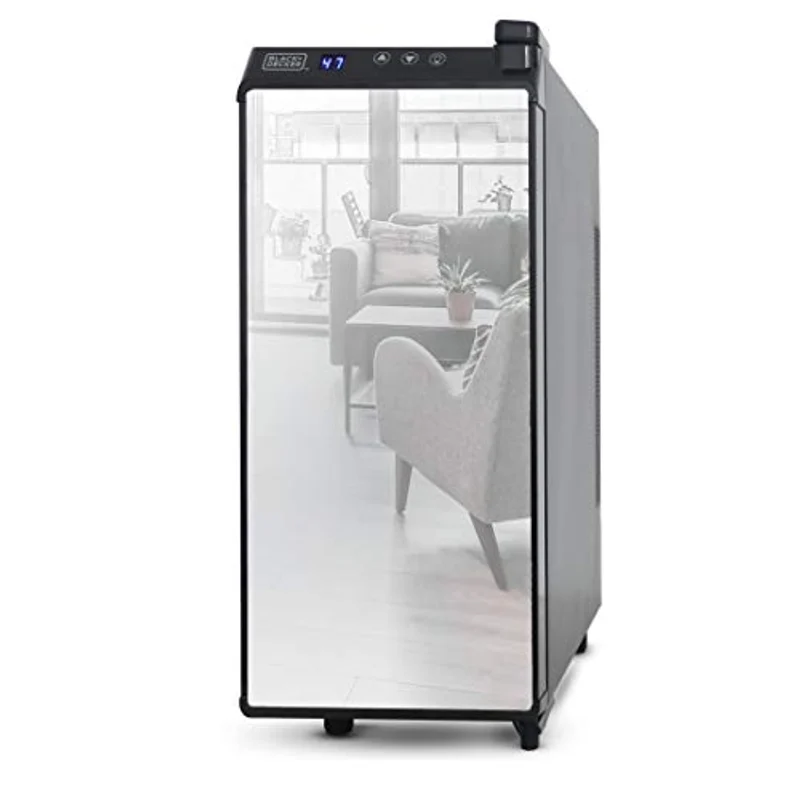
BLACK+DECKER BD60336 12-Bottle Thermoelectric

Best for: a ten-inch gap in a climate-controlled room

12 bottles·Thermoelectric·Mirrored door·28.3 lb

Twelve bottles in a cabinet roughly 10 inches wide and 20.4 inches tall is the genuinely clever part of this unit — that is a slot beside a fridge, at the end of a counter run, or on a narrow sideboard where nothing else on this page fits. It weighs 28.3 lb, so one person can move it. The mirrored door hides the contents and looks considerably better in a living room than a lit glass front. Thermoelectric cooling means no compressor, no hum and no vibration.

The honest downsides: it is the most expensive unit here at $185.99 and it is thermoelectric, which is the combination we spend this whole article warning about. In a room that stays near 72°F it is excellent. In a kitchen that reaches the low eighties in summer it will not hold cellar temperature, and no setting will make it. Buy it for the footprint and the silence, with your eyes open about the ambient limit — not because it is the priciest and therefore the best.

The right unit for a narrow gap in a cool room, and the wrong one everywhere else.

BLACK+DECKER BD60336 12-Bottle Thermoelectric Wine Chiller with mirrored door
Price
$185.99
Check price →
04The one with a key

ORYMUSE 12 Bottle Mini Wine Fridge with Lock

Best for: shared houses, offices, and homes with teenagers

12 bottles·Compressor·Lock·Freestanding

A lock is a rare specification under $200 — the feature usually appears two or three hundred dollars higher — and if you need one, nothing else on this page will do. The obvious cases are a shared flat, a home with curious teenagers, an office break room, a short-term rental you host, or a small business that keeps a few bottles for clients. The useful part is that ORYMUSE did not pay for the lock by dropping to thermoelectric: this is a compressor unit, so it also holds temperature properly.

The honest downsides: $179.99 for twelve slots is about $15.00 a slot, roughly $50 more than the same capacity from Winado, and the lock is essentially the whole difference. It is a cabinet lock on a glass-fronted appliance, so it deters rather than secures — the honest description is that it stops casual access, not a determined effort. And like every compressor unit here, it hums.

Pay the $50 only if the key is the point. If it is, this is the only answer under $200.

ORYMUSE 12 Bottle Mini Wine Fridge with lock, freestanding compressor
Price
$179.99
Check price →
05The one that looks the part

FOHERE 8 Bottle Small Wine Fridge

Best for: a small unit that has to look good on show

8 bottles·Double glass doors·LED light·Countertop

Most cheap wine coolers look cheap, and this is the one that does not. The double glass door and interior LED give it the front-of-house appearance of a much more expensive cabinet, which matters if it is going on a bar cart, a sideboard, a dining-room credenza or anywhere guests will see it rather than in a utility corner. Eight advertised slots, about six in practice, in a countertop footprint.

The honest downsides: $139.99 for eight slots is $17.50 a slot, and the listing does not state the cooling method plainly — at this size and price, buy it assuming thermoelectric behaviour and its 20°F ambient limit. The glass doors and the LED that make it attractive are also the two things that let heat and light into the cabinet, so keep it out of the sun and leave the light off unless you are choosing a bottle.

You are buying the front panel here. That is a legitimate thing to buy, as long as you know it.

FOHERE 8 Bottle small wine fridge with double glass doors and LED light
Price
$139.99
Check price →
06Smallest name-brand

BLACK+DECKER BD60016 6-Bottle Thermoelectric

Best for: a bedroom, a study, or a household that opens two bottles a week

6 bottles·Thermoelectric·Silent·Black finish

Six bottles is not storage; it is a holding pen for what you are drinking this fortnight, and for a lot of households that is exactly the right appliance. No compressor means no hum and no vibration, which is why this belongs three feet from a desk or a bed where a cheap compressor unit would be intolerable. BLACK+DECKER is a recognised brand with a real US support line, which is worth something when the alternative at this price is a name you have never heard of.

The honest downsides: at $129.99 it is the most expensive storage on this page, about $21.70 a slot, and the 70–80% capacity rule bites hardest here — six advertised slots can mean four Burgundy bottles. Same thermoelectric ambient limit as every unit of its type. And it costs the same as the twelve-bottle Winado compressor, which is a comparison worth sitting with before you buy.

Right for silence in a small cool room. Poor value for anyone who just wants bottles cold.

BLACK+DECKER BD60016 6-Bottle Thermoelectric Wine Cellar in black
Price
$129.99
Check price →
07Cheapest way in

EUHOMY 18L Mini Wine Fridge

Best for: a dorm room, a first apartment, or testing whether you want one at all

18 litres (~6 bottles)·Countertop·Freestanding·Under $115

At $111.99 this is the lowest price of entry on the page, and there is a real use for it: a studio apartment, a dorm, a desk-side cabinet, a guest room, or simply finding out whether a dedicated wine fridge changes how you drink before spending $400 on one. Eighteen litres works out to roughly six bottles laid down. It is small and light enough to move without help, which the larger compressor units here are not.

The honest downsides: it is sold as a mini fridge as much as a wine cooler, the cooling method is not stated plainly, and the sensible assumption at this size and price is thermoelectric with the usual ambient ceiling. Expect the coarsest temperature control here and the thinnest insulation. At roughly $18.70 a bottle slot it is cheap in absolute terms and expensive per bottle — another $48 buys the eighteen-bottle ROVSUN with real compressor cooling, which is the upgrade almost everyone should make if the counter space exists.

A genuinely low-risk way to start. Just do not mistake it for the destination.

EUHOMY 18L mini wine fridge, freestanding countertop wine cooler
Price
$111.99
Check price →
Honesty section

When to skip this price band entirely

There are three situations where the best advice we can give is to spend nothing here.

The room gets genuinely hot

A garage, a sunroom, a converted attic, an apartment without air conditioning, or a kitchen in a hot state during summer. Thermoelectric is out by definition, and the compressor units at this price have thin insulation and small condensers — they will hold temperature but run close to continuously, which is exactly the duty cycle that kills a one-year-warranty sealed system. If the room is hot, put the money toward a better-insulated compressor unit rather than buying twice.

You want to age anything

Nothing under $200 is a cellar. No humidity control, no carbon filter, thin glazing, a thermostat that steps in whole degrees, and vibration from a cheap compressor sitting under the bottles — none of that is a problem for wine you will open within a year or two, and all of it matters for a bottle you intend to lay down for ten. If your goal is ageing, this is the wrong category, not the wrong model. Start with what a wine fridge should actually be set to and then budget for a cabinet that can hold it.

You already own twenty-plus bottles

The most common expensive mistake in this category is buying small twice. A twelve-bottle unit bought by someone with a growing collection is full within a season, and the second purchase makes the first one redundant rather than additive. If you already have twenty bottles, or you buy by the case, skip straight to a 28-bottle or larger cabinet — and if you are torn on zones while you are there, the single-versus-dual decision is worked through here. The rest of the field is on our main wine fridge guide.

If the budget can move

The one worth stretching for

If $200 is a preference rather than a hard ceiling, the honest recommendation is to double it. The Ivation 28 Bottle Dual Zone at $399.99 is our overall top pick for the site, and it resolves every compromise on this page at once: compressor cooling, two independently set zones across a 41–64°F range, a lock, UV-resistant double-paned glass, and roughly twenty real bottles of usable capacity. That is not a slightly better version of what is above — it is a different class of appliance, and for anyone who expects to still be using it in five years, the cost per year is lower than a $130 unit replaced twice.

That is the only mention it gets here. If your budget genuinely stops at $200, the ROVSUN is the pick and it is a good one.

Our method

How we picked — and what we cannot tell you

What we did

Specs, prices and owner reports

We compared the published specifications and current US prices for the small wine coolers we could find listed under $200, then cross-checked each shortlisted unit against the pattern that repeats across verified owner reviews. Where a listing does not state something plainly — cooling method, most often — we say so on the page rather than filling the gap with a guess presented as fact.

What we didn't

We do not run a testing lab

We do not physically test these units, we do not own them, and we publish no scores out of ten. This site also shows no star ratings or review counts for wine fridges, because the retailer data feed does not return them for this category and we will not estimate a number that looks like a measurement. What we can do honestly is read the specifications carefully, track the prices, and tell you what the compromises actually cost you.

FAQ

Common questions

Is a $130 compressor wine fridge really better than a $185 thermoelectric one?

In any room that gets warm, yes, and it is not close. A thermoelectric unit can only cool to roughly 20°F below the ambient temperature, so in a kitchen that reaches 82°F in August it cannot get below about 62°F no matter what the display says. A compressor unit runs a real refrigeration cycle and holds its setpoint regardless. You pay for that with an intermittent hum. If the unit is going somewhere silence matters and the room is climate-controlled year round, thermoelectric is a fair choice — otherwise buy the compressor.

How many bottles will a “12 bottle” wine fridge actually hold?

Usually eight to ten. Advertised capacities assume slim Bordeaux bottles stacked perfectly; Burgundy, Pinot and Champagne bottles are wider and cost you neighbouring slots. Plan on 70–80% of the stated number. On a six-bottle unit that can mean four real bottles, which is why capacity per dollar is worth calculating before you buy at this end of the market.

Can I put one of these under my kitchen counter?

No. Every unit on this page is freestanding, meaning it vents its heat out of the back and sides. Enclosing it traps that heat, which makes a compressor run continuously and fail early, and makes a thermoelectric unit stop reaching temperature altogether. Only a model rated by its manufacturer as built-in, venting through a front grille, may go in a cabinet run — and that capability starts above this price band. Leave two to four inches of clear air behind and above any unit here.

Will a wine fridge under $200 age wine properly?

No, and it is not designed to. Ageing needs stable temperature, some humidity, darkness and an absence of vibration over years. Units at this price have thin insulation, no humidity control, no carbon filter and a coarse thermostat. What they do well is hold everyday bottles at a sensible, steady drinking temperature, which is a genuinely useful job and far better than the 37°F of a kitchen fridge. If your goal is a cellar, this is the wrong category rather than the wrong model.

Keep reading

The guides behind these picks

More on the full range, including the larger cabinets worth stretching for, in our main wine fridge guide and the complete library of guides.