Reader-supported: we may earn a commission when you buy through the links on this page, at no additional cost to you. Prices below were correct at the time of writing and change often — confirm on Amazon before you buy.
A wine fridge does not fail because you set it to the wrong temperature. It fails because the heat it makes has nowhere to go. Every compressor-cooled unit is a heat pump: it moves warmth out of the cabinet and dumps it into the room. Where it dumps that warmth is the single specification that decides whether the appliance can live inside a cabinet — and it is the thing buyers skip past on the listing page.
Get it right and a $500 fridge sits under a counter for a decade. Get it wrong and a $400 fridge that would have run happily in open air turns into a machine that runs constantly, never quite reaches its setpoint, drives up the power bill, and gives out around month fourteen — just past the one-year warranty, and in many cases with the warranty voided anyway because the manual said not to enclose it.
- The physics: where the heat actually goes
- What happens when you enclose a freestanding unit
- How to tell which one you are looking at
- The measurements that decide the install
- Built-in capable units worth knowing
- Freestanding units worth knowing
- If you already own a freestanding unit
- What the built-in premium buys
- Which one for your situation
- Common questions
The physics: where the heat actually goes
Strip away the glass door and the wooden shelves and a compressor wine fridge is your kitchen refrigerator, shrunk. A refrigerant circulates. Inside the cabinet it absorbs heat from the air around your bottles; the compressor squeezes it, raising its temperature well above the room's; then it passes through a condenser coil where that heat is shed, usually with a fan pushing air across it.
None of that is optional. A wine fridge holding 33 bottles at 55°F in a 75°F kitchen is a small heater pointed at your room, and it has to be, because that is how cooling works. The only design question is which face of the cabinet it points at.
Freestanding: heat out the back and sides
On a freestanding unit the condenser coil sits on or near the rear panel, and the side panels often act as secondary heat-shedding surfaces. Air is drawn in low, passes over the coil, and rises off the back by convection with a fan's help. It is a cheap, effective, quiet layout — as long as there is open air behind and above. The manufacturer states a clearance, and the whole design assumes warm air can rise away and be replaced by cooler room air.
Built-in: heat out the front, at the bottom
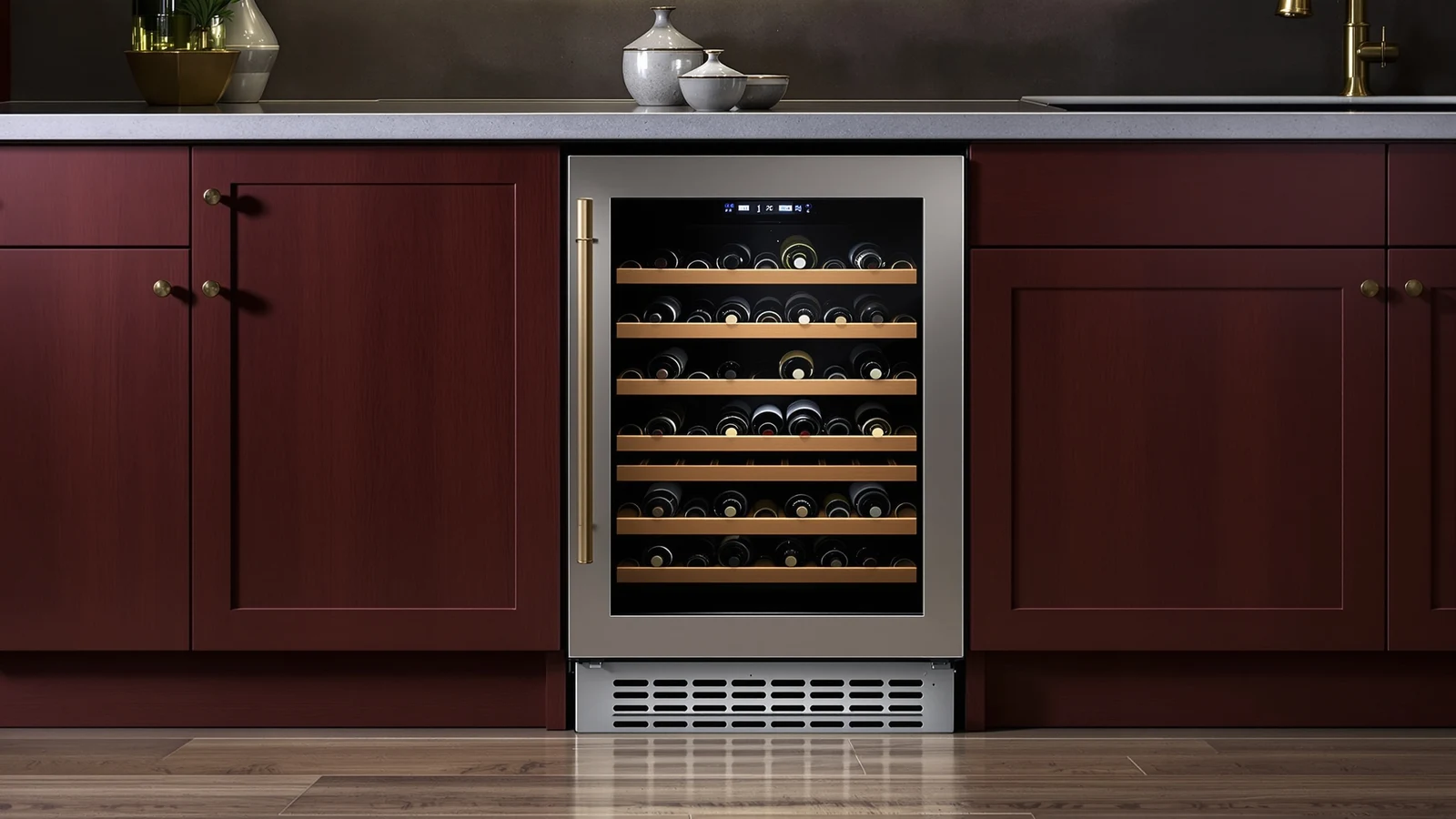
A built-in or undercounter model is engineered around the opposite assumption: that five of its six faces will be pressed against cabinetry. The condenser and its fan move to the base, behind a ventilation grille running across the front, just under the door. Room air is drawn in through one part of that grille, pushed across the coil, and exhausted through another — all at the front, all into the open room. The sides and back can then sit tight against plywood, because they are no longer doing thermal work.
Front-venting is not a feature. It is a different machine, engineered around a different assumption about where the air is.
That relocation costs money: a different chassis, a redesigned airflow path, a stronger fan to push air out through a grille, and a cooling system sized for a hotter, more demanding duty cycle. It is why built-in capable models cost more for the same bottle count, and why the two categories are not interchangeable.
One direction of the swap is always safe. A built-in capable unit runs perfectly well standing free — it is venting into open air instead of a cabinet opening, which is the easier job. The reverse is never true.
What happens when you enclose a freestanding unit
You slide a rear-venting unit into a cabinet gap. The compressor sheds heat off the back panel, that warm air rises into the few inches of dead space behind the fridge, and it stays there — the top is capped by a countertop and the sides by cabinet walls. Within an hour or two, the air the condenser is trying to shed heat into is no longer 75°F room air. It is 90°F or hotter, and climbing.
A condenser can only reject heat into air cooler than the refrigerant, so as that cavity warms, the temperature difference the system depends on collapses. The interior stops dropping. The thermostat, seeing an interior above setpoint, does the only thing it can: keep the compressor running — which adds more heat to the cavity. The loop feeds itself.
The symptoms owners report, in the order they usually notice them:
- It never turns off. A healthy wine fridge cycles — a few minutes of hum, then a stretch of quiet. An enclosed one hums permanently. This is the first and clearest sign.
- It will not hit the number. The display says 55°F, a thermometer inside says 63°F, and turning the dial down does nothing. On a warm afternoon the gap widens.
- The bill goes up. A unit running at 100% duty instead of cycling at 40% draws power for more than twice as many hours a day. Modest in dollars; loud as a symptom.
- Condensation. A cabinet that cannot hold setpoint in humid air often sweats on the inside of the glass, and sometimes on the door seal.
- Then it stops. Sealed systems are rated for a duty cycle and a condensing temperature. Run permanently, hot, the compressor's windings and lubricant run hotter than designed. Failures cluster in the twelve-to-twenty-four-month window — right after a typical one-year parts-and-labor warranty expires.
Freestanding wine fridge manuals routinely state that the product is for freestanding use only and that installing it in an enclosed space voids the warranty. So the failure the installation caused is also the failure the warranty will not cover. Check the manual for your specific model before you commit to a cabinet opening — wording and required clearances vary by manufacturer, and the manual is the only authority that counts.
If your unit is already showing the first two symptoms, it is worth working through the cooling-failure checklist before you conclude the appliance is defective. Airflow and ambient temperature explain the large majority of complaints, and installation is the biggest airflow variable of all.
How to tell which one you are looking at
Listings are written to sell, and a photograph of a wine fridge sitting neatly beneath a marble counter is a styling decision, not a rating. Here is how we read a listing, in order of how much the signal is worth.
1. Look for the grille at the base of the front
This is the physical tell, and it is hard to fake. A built-in capable unit has a ventilation grille — a slotted or louvered strip, usually the full width of the cabinet — at the very bottom of the front face, below the door. If the front is a clean sheet of glass and stainless from the floor up, with nothing but a foot or a plinth at the base, it vents somewhere else. Zoom in on the bottom two inches of the product photo.
2. Look for the manufacturer's own words
Take the specification block seriously and the marketing copy sceptically. The phrases that mean something are built-in, undercounter, and built-in or freestanding. Where a brand states the installation type explicitly — the Whynter BSR-033SW and BWR-1002SD both do, as does the Kalamera 24-inch — you can rely on it. Where a listing is silent, assume freestanding: a manufacturer who paid for a front-venting chassis will tell you, because it is the expensive feature. Watch too for the qualifier "with proper clearance", which is doing real work — it means the opening must be cut to their numbers, not to your cabinet's existing size.
3. Read the stated clearances
A freestanding unit's manual asks for meaningful space at the rear, the sides and above. A built-in capable unit's instructions concentrate instead on the cabinet opening's dimensions and on the front grille staying unobstructed. Either set of instructions tells you what you need to know. Follow the numbers in your specific model's manual rather than a rule of thumb from an article — including this one.
4. Discount the styled photograph
A unit shown under a counter in the hero image, with no built-in claim anywhere in the specification block, is a rear-venting unit that a photographer put under a counter. Reviewers consistently note discovering this after installation rather than before — the most repeated regret in owner reviews across the category.
The measurements that decide the install
Once you know a unit is allowed in a cabinet, the question becomes whether it fits the one you have. Three numbers, and a fourth thing nobody thinks about.
Width. The undercounter world has settled on a few standard widths, and 15 inches is the common one for wine fridges — the width of the trash pullout or narrow base cabinet people usually sacrifice. Both the Whynter BSR-033SW and the Techomey below are 15-inch models for that reason. Twenty-four inches is the other standard, matching a dishwasher opening, which is what the Kalamera is built for. Measure the opening itself, not the cabinet door.
Depth. Base cabinets run around 24 inches deep with the counter overhanging beyond. Check whether the manufacturer's depth figure includes the door and handle: a unit 22 inches deep in the body and 24 with a protruding handle stands proud of the cabinet run, which reads as a mistake even though it works fine.
Height. Floor of the opening to the underside of the counter is usually about 34 inches. Undercounter models are built for that, and the leveling feet give a little adjustment.
Door swing. The one that gets forgotten. In an open room you can turn a freestanding fridge around; in a cabinet you cannot, and a door opening into the corner of an L-shaped counter or the path of the oven door is a permanent daily annoyance. Check whether the door is reversible — the Whynter BWR-1002SD says so explicitly — and check what it hits at 90 degrees before you cut anything.
Built-in capable units worth knowing
These are units the manufacturer describes as suitable for built-in or undercounter installation, and all of them can stand free if your plans change. We compared published specifications, current prices and the pattern in owner reports; we do not physically test these units and we do not run a testing lab.
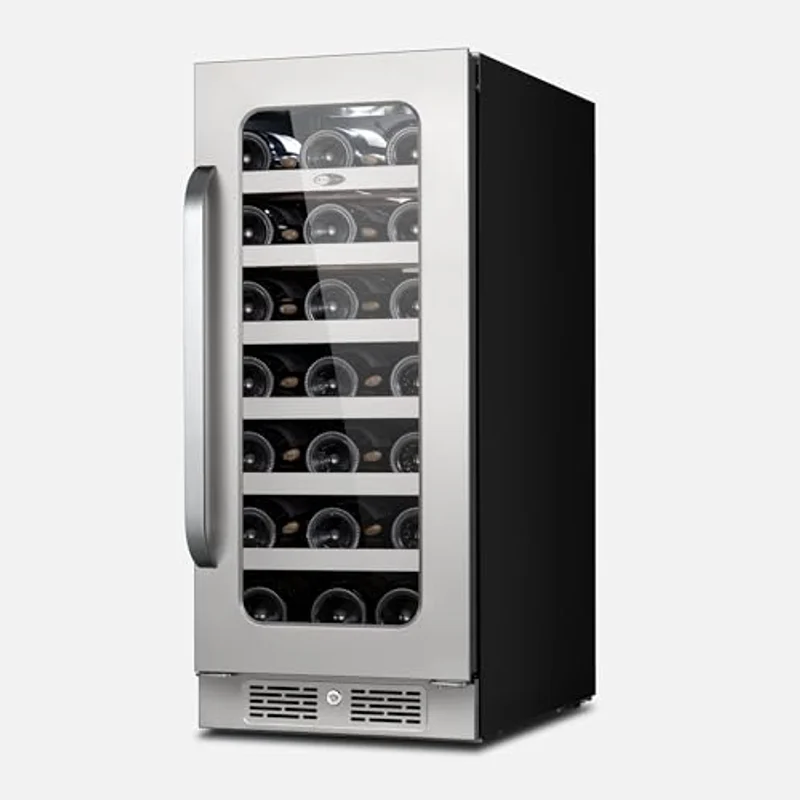
Whynter BSR-033SW 15" Built-In Undercounter
The standard answer for a 15-inch cabinet gap
Thirty-three bottles inside three cubic feet is an efficient use of a 15-inch opening, and Whynter states the built-in and freestanding options with proper clearance rather than leaving you to infer them from a photograph. Single zone, which is the right call at this width — split a 15-inch cabinet and neither half holds enough to be useful.
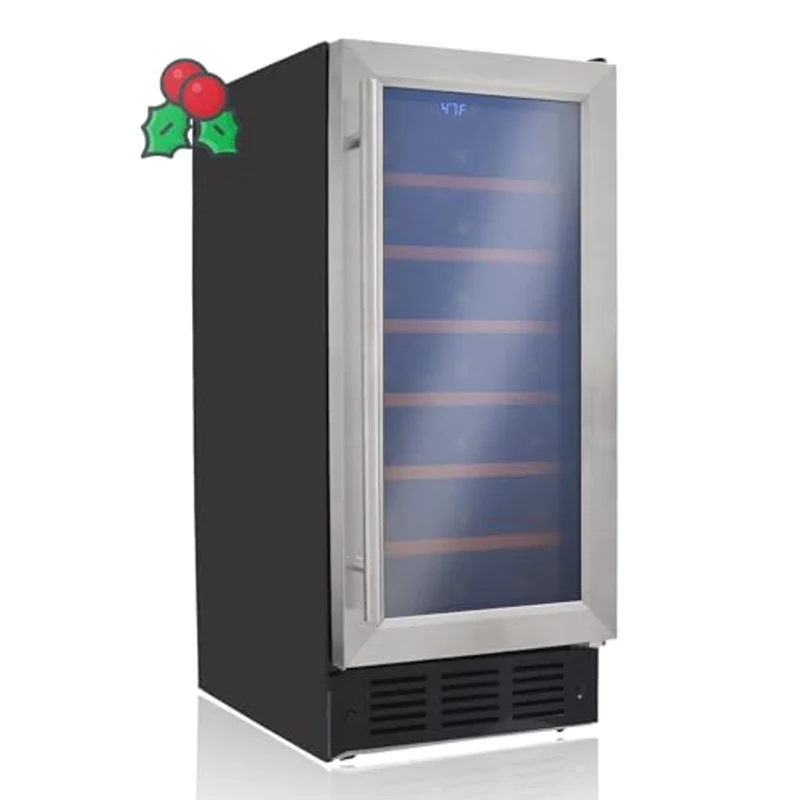
Techomey 15 Inch Under Counter Wine Fridge
The lower-cost route into the same opening
Thirty-one bottles in the same standard 15-inch footprint for roughly half the price of the Whynter — a genuine saving rather than a trick, because the built-in chassis is the expensive part and it is present. What you give up is generally fit and finish, and the depth of the brand's support if something goes wrong. If the alternative was a freestanding unit shoved into the gap, this is the cheapest honest way to avoid that.
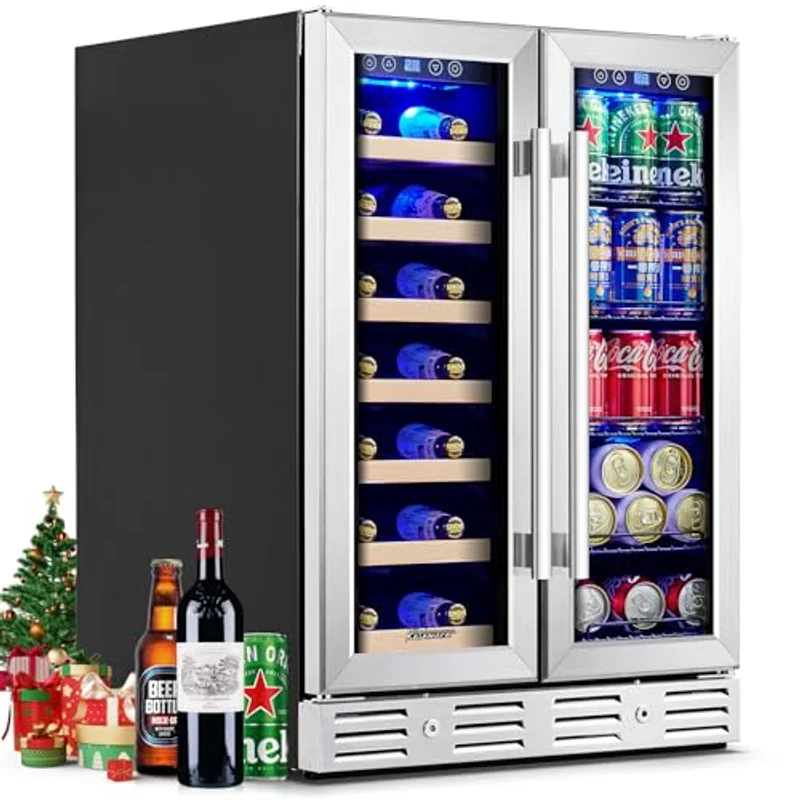
Kalamera 24 Inch Dual Zone
For a dishwasher-width opening, wine and cans together
A 24-inch opening is the other standard undercounter size, and this fills it with two independently controlled sides: wine at cellar temperature, cans at drinking temperature. The compromise is honest — 21 bottles is far fewer than a 24-inch all-wine cabinet holds — so it is worth it only if the can side earns its half. On the two-zone question generally, we work through it here.
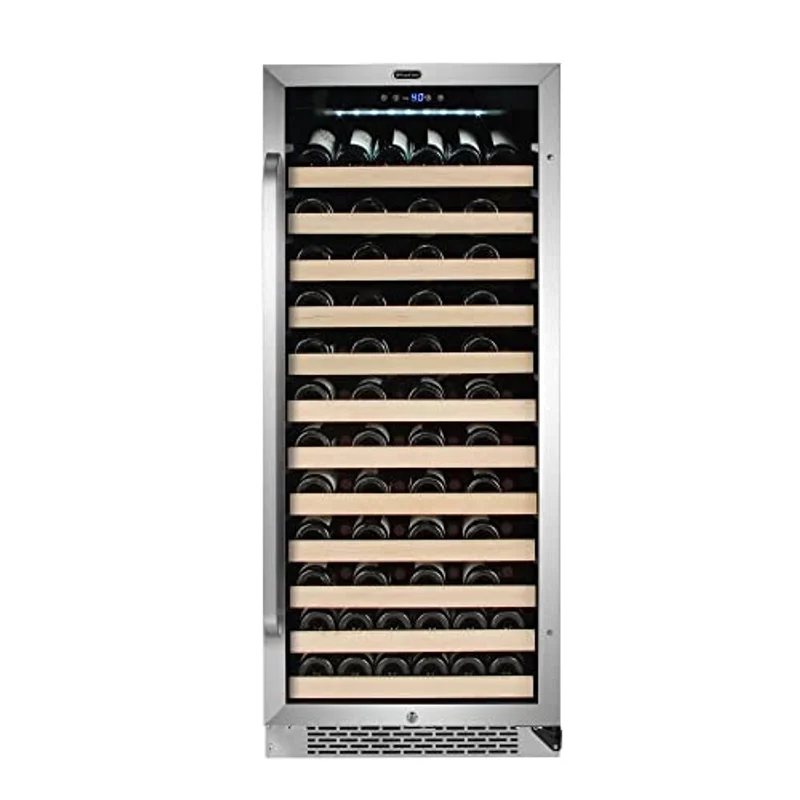
Whynter BWR-1002SD 100 Bottle
When the collection outgrows a cabinet gap
One hundred standard bottles, or ninety with the display shelf fitted, rated by Whynter for built-in or freestanding installation. At this height the specification that matters most is fan-forced internal circulation: a tall cabinet without it stratifies, and the top shelf runs several degrees warmer than the bottom. Note the reversible door at planning stage — a cabinet this size is not something you turn around later.
Freestanding units worth knowing
These are rear or side-venting units. They are excellent appliances and generally cheaper per bottle than the built-in equivalents — provided you have open air for them. Do not enclose them.
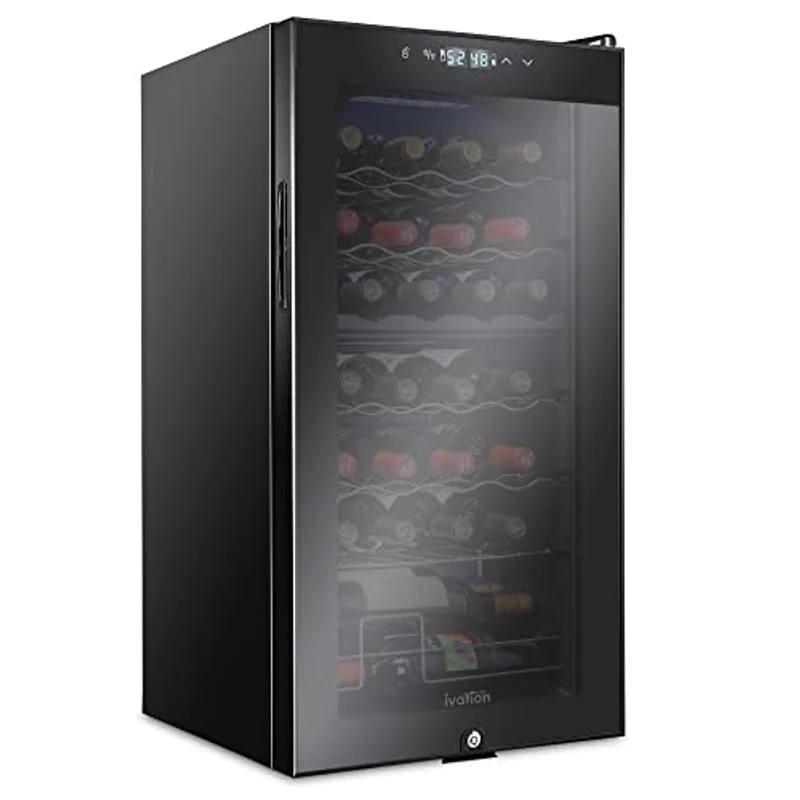
Ivation 28 Bottle Dual Zone
The best all-round freestanding unit
Two genuine zones, compressor cooling that holds its number whatever the kitchen is doing, and a lock — at a price where much of the category still sells a single thermoelectric zone. The 41 to 64°F range runs one zone as a serving fridge for whites and the other as true cellar storage. The rule that comes with it: it needs breathing room behind and above, so it belongs at the end of a run or against a wall, not inside a cabinet.
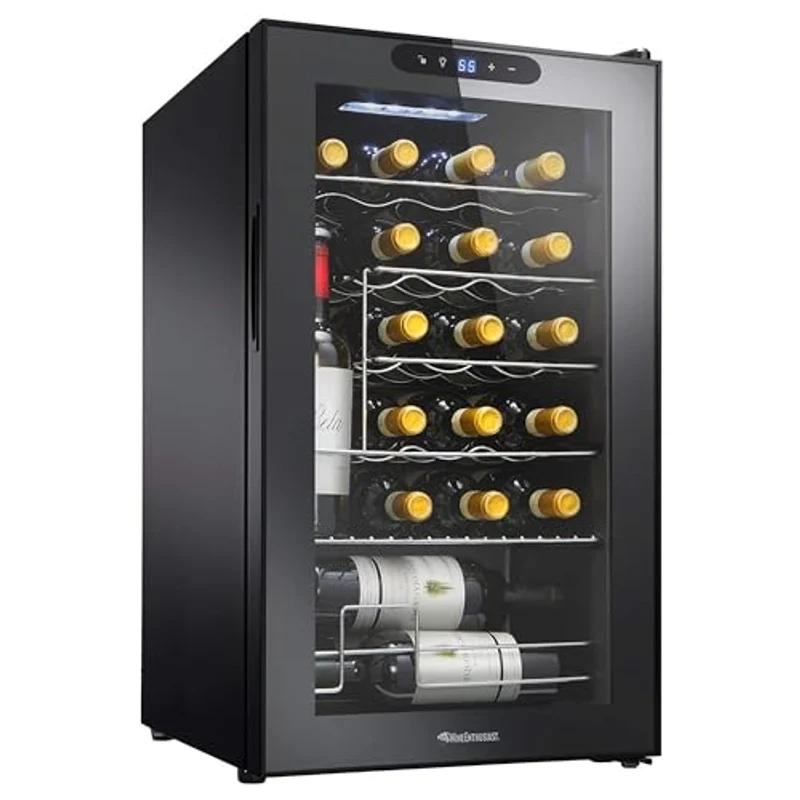
Wine Enthusiast 24-Bottle Compressor
Upright storage, open floor space
A compact 2.4 cubic foot cabinet from a brand long established in wine storage, with upright bottle storage rather than horizontal racks — useful if you turn bottles over quickly and want to read labels without pulling shelves, less ideal for years-long cork-down storage. Freestanding, so treat the space behind it as part of the appliance.
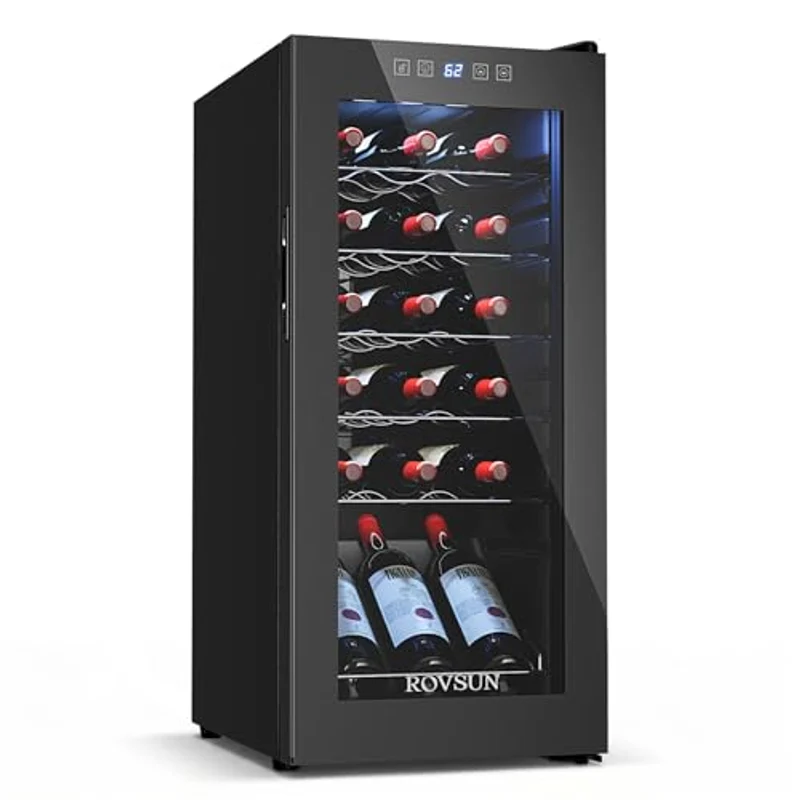
ROVSUN 18 Bottle Freestanding Compressor
The cheapest real compressor
The least expensive way to get compressor cooling rather than a thermoelectric unit that loses control when the room warms up. The shelves are wire rather than wood and there is one zone, but the part that decides whether your wine survives August is the part that was not cut. If your budget lands here, the other option worth reading is what else $110 to $190 actually buys.
If you already own a freestanding unit
Most people reading this already own one, and the cabinet gap is already there. The honest position here is a compromise rather than a rule.
Start with the manual's clearance section — the model-specific numbers are the only ones that count. As a general shape, a freestanding unit wants space at the rear, some at the sides, and the most of all above, because the exhaust plume rises. Give it what the manual asks for and it behaves as designed.
Then understand why an open-back alcove is still not a built-in installation. Removing the cabinet's back panel and leaving the top open helps enormously, and if it is your only option it is the option to take — but it is not equivalent. The exhaust still travels a restricted path rather than into open room air, the cabinet sides still radiate heat back at the unit, and the airflow now depends on the space behind the cabinet, which in an island is often another closed cavity. Expect a longer duty cycle than the same unit standing free, and check the interior with an independent thermometer instead of trusting the display.
If the interior sits several degrees above setpoint after 24 hours, treat that as the answer: pull the unit into open air and see whether the number comes down. If it does, the installation was the problem, and no repair will fix it.
The reverse swap is always safe. Any built-in capable unit will happily stand free — venting into an open room is the easy case, not the hard one.
What the built-in premium buys
Compare like for like on this page and the pattern is clear. The Whynter BSR-033SW holds 33 bottles for $499.99 with a built-in rating; the Ivation holds 28 for $349.99 without one. The Techomey shows the floor of the built-in category at $259.99 for 31 bottles, while the ROVSUN shows the floor of the freestanding category at $169.99 for 18. Roughly speaking, at any given capacity, the built-in capable version carries a premium of somewhere between a quarter and a half of the price.
That premium is not brand positioning. You are paying for a redesigned chassis with the condenser and fan at the base, a front grille and the airflow path behind it, and a cooling system specified for a hotter, more restricted intake than a freestanding unit ever sees — a different bill of materials for the same bottle count.
Which makes the decision easy to frame. Going into a cabinet: the premium is not optional, and it is cheap next to replacing a dead unit and repairing cabinetry in two years. Standing in open air: you are paying for engineering you will never use, so put the money into capacity, a second zone or better shelving. The one exception — if there is a real chance the appliance moves into a cabinet in a future remodel, buying built-in capable now is inexpensive insurance, because running one in the open costs you nothing.
Which one for your situation
A kitchen island or a run of cabinets
Built-in capable, no exceptions. An island is the worst possible environment for a rear-venting unit because the cavity behind it is usually sealed on all sides. Measure the opening, confirm the width against a 15 or 24-inch model, and check the door swing against the traffic path around the island.
An existing cabinet gap you want to fill
Built-in capable, and measure before you shop rather than after. Most gaps left by a removed trash pullout or narrow base cabinet are close to 15 inches, which is why that width dominates. A dishwasher-sized gap puts you in 24-inch territory.
Open floor space, a dining room, or the end of a counter
Freestanding, and enjoy the saving — this is the case the cheaper design was built for. Leave the clearance the manual asks for behind and above, keep it out of direct sun, and keep it clear of the oven and the dishwasher's exhaust.
A garage or a basement
Freestanding is fine on the venting question, but ambient temperature becomes the deciding factor instead. A garage reaching 95°F in summer is hard on any wine fridge and impossible for a thermoelectric model — a separate decision covered in the thermoelectric versus compressor comparison. Compressor cooling and generous clearance are the minimum here.
An apartment or a rental
Freestanding, almost always: you are unlikely to be cutting cabinetry, and the unit moves with you. The thing to watch in a small apartment is noise, since a compressor cycling at night is audible in a studio.
You have not decided where it goes yet
Buy built-in capable. It is the only choice that keeps both options open, and the premium is the price of not having to guess right.
How we researched this
We compared published manufacturer specifications, installation guidance and current US prices, and read the patterns that repeat across verified owner reviews. We do not physically test these units, we do not own them, and we do not run a testing lab or publish scores out of ten. This category also does not give us star ratings or review counts to work from — the retailer's product data returns none for wine fridges — so you will not find either quoted anywhere on this site. What we can do honestly is read the specifications carefully, explain what they mean, and tell you where the owner reports and the spec sheet disagree.
Common questions
Can I put a freestanding wine fridge under my counter?
No. A freestanding unit rejects its heat out of the back and sides, and an enclosed cabinet traps that heat against the condenser. The compressor then runs continuously, the interior never reaches setpoint, energy use climbs, and the sealed system tends to fail early — commonly just outside the one-year warranty, which many manufacturers void for enclosed installation anyway. Only a model the manufacturer rates for built-in or undercounter use, which vents through a grille at the front, may go into a cabinet run.
How can I tell if a wine fridge is built-in capable before I buy it?
Three checks. Look at the bottom of the front face in the product photos for a ventilation grille running across the width, below the door. Look in the specification block for the manufacturer's own words: built-in, undercounter, or built-in or freestanding. And read the stated clearances — a built-in capable model's instructions focus on the cabinet opening and an unobstructed front grille, while a freestanding model's focus on space at the rear, sides and top. A marketing photograph showing the unit under a counter proves nothing.
Can a built-in wine fridge be used freestanding?
Yes, and this direction is always safe. A front-venting unit exhausts into open room air just as happily as into a cabinet opening — in fact more easily, since there is no restriction. It is only the reverse swap, putting a freestanding unit into an enclosure, that damages the appliance.
Is it enough to remove the cabinet's back panel?
It helps a great deal and it is far better than a sealed box, but it is not the same thing as a built-in installation. The exhaust still travels through a restricted path, the cabinet sides still radiate heat back at the unit, and in an island the space behind the cabinet is often another closed cavity. If that is your only option, follow the clearance figures in your model's manual, put an independent thermometer inside, and check after 24 hours whether the interior actually reaches setpoint.
Why do built-in wine fridges cost more for the same number of bottles?
Because the condenser, the fan and the entire airflow path have been relocated to the base of the cabinet and routed out through a front grille, and the cooling system is specified for a hotter, more restricted intake. That is a different chassis and a different bill of materials, not a badge. Expect roughly a quarter to a half more than a comparable freestanding unit.