Best Wine Fridges
Troubleshooting

Wine fridge not cooling? Work through this before you replace it.

Most wine fridges that stop cooling are not broken. They are a freestanding unit shoved into a cabinet, a thermoelectric unit in a room that got hot, a condenser buried in dust, or a door that never quite closes. Here are the checks in the order that actually pays off.

Wine refrigerator with its glass door open, bottles on the racks, in a dim kitchen
The failure people call “not cooling” is usually the cabinet losing a fight with the room around it, not the refrigeration circuit inside it.

Reader-supported: some links on this page are affiliate links, and we may earn a commission if you buy through them, at no additional cost to you. It does not change what we recommend — and on a page about not replacing your appliance, that is worth saying out loud.

Start here

Before you assume it’s dead

A wine fridge that reads 68°F when it is set to 55°F feels like a failure, and the first instinct is to look up a repair number or a replacement. Hold that thought for twenty minutes. We compared the specifications of dozens of wine coolers against what owners report going wrong with them, and the pattern is consistent: the large majority of “not cooling” complaints are environmental or installational. The refrigeration system is doing what it was designed to do. It is being asked to do it in conditions it was never rated for.

That matters financially. A sealed-system repair on a wine cooler frequently costs more than the unit did — a service call, a diagnosis, a technician’s time and a recovery-and-recharge procedure can total several hundred dollars on an appliance that sold for $200. So the order of operations here is deliberate: the free checks first, the cheap checks next, and the expensive conclusion last, only once everything above it is ruled out.

Work down this list in order. Each step is something an owner can safely do with no tools beyond a vacuum, a flashlight and a thermometer.

Read this part

Safety, and the warranty you might still have

A wine fridge is a mains-powered appliance containing a sealed refrigeration circuit under pressure. Everything in this guide is deliberately limited to what a normal owner can do safely: unplugging, looking, cleaning, measuring, adjusting a door, moving the unit. None of it involves opening the machine.

Do not do these things

  • Do not open the sealed refrigerant system. The tubing, the compressor and the evaporator are a closed circuit charged with refrigerant. Cutting, piercing or unbrazing any of it releases that charge.
  • Do not try to “top up” or recharge the refrigerant. Household wine coolers are not designed to be recharged, there is no service port on most of them, and in the United States venting refrigerant is illegal — handling it requires EPA Section 608 certification. The DIY recharge kits sold for cars have no business anywhere near this appliance.
  • Do not service internal electrical components. The compressor start relay, the thermostat, the control board and the fan motors sit on live mains wiring. Leave them to a qualified appliance technician.
  • Unplug the unit before cleaning anything — the vent grille, the condenser coils, the interior. Not “switch it off at the panel.” Unplug it at the wall.
  • Do not run it on an extension cord or a power strip. Compressors draw a large inrush current at start-up, and manufacturers specify a dedicated grounded outlet for exactly that reason.

Check the warranty before you touch anything

This is the step people skip and regret. Wine cooler warranties are typically split: one period for the whole unit, parts and labor, and a longer period for the sealed system alone — the compressor, the condenser, the evaporator and the connecting tubing. One year on the cabinet and five years on the sealed system is a common shape of the deal, and some brands go further. If the failure genuinely is the compressor, that longer clock is the difference between a free repair and a dead appliance.

So before you unscrew a back panel or take anything apart, find the model number, find the purchase date and read the warranty terms. Cleaning a condenser and levelling a cabinet are routine owner maintenance and will not void anything. Dismantling the refrigeration circuit will void everything, and will do it on the exact component the manufacturer might otherwise have replaced for free.

Fast diagnosis

Symptom to cause, at a glance

Find the row that matches what your unit is actually doing. Then read the linked section — the short answer here is rarely the whole story.

What you’re seeingMost likely causeWhat to do
Holds ~20°F below the room and no colder Thermoelectric unit at its physical limit Cool the room, or move to a compressor unit
Runs constantly, never reaches setpoint, cabinet sides hot Heat cannot escape — blocked clearance or an enclosed freestanding unit Pull it out and give it air
Gradually got worse over a year or two Condenser coils packed with dust Unplug and vacuum the coils
Condensation or frost inside, warm patch near the door Door seal leaking, or door not closing fully Check the gasket and the levelling
New unit, or just loaded with room-temperature bottles Normal pull-down — it has not had time yet Give it 24 hours before judging it
Display looks normal but nothing gets cold; no compressor sound at all Demo/showroom mode, a lock, or a °C/°F mix-up Reset the panel and confirm the units
Top shelves warm, bottom shelves fine Blocked internal airflow, or a single-zone cabinet stratifying Unblock the rear vent, redistribute bottles
Completely dead — no light, no display Tripped GFCI, tripped breaker, or a shared circuit Check the outlet before the appliance
Clicking every few minutes, or a loud hum and no cold Compressor failing to start, or a failed fan or thermostat Time for a technician, not a screwdriver
Cause 01

1It is thermoelectric, and your room got warm

This is the single most common “my wine fridge stopped cooling” complaint, and in most cases nothing has stopped working at all.

A thermoelectric cooler has no compressor and no refrigerant. It uses a Peltier module: a solid-state device that, when current runs through it, pumps heat from one face to the other. It is silent, it does not vibrate, and it is wonderfully simple. It is also fundamentally limited. A Peltier module can only move heat across a certain gradient, so a household wine cooler built on one will pull roughly 20°F below the temperature of the room it stands in — a little more in a well-insulated cabinet, a little less in a cheap one.

Do the arithmetic with your own house. In a room held at 72°F, a thermoelectric unit reaches about 52°F. Perfect. That same unit in a kitchen that climbs to 80°F in the afternoon reaches about 60°F. In a room that hits 88°F in August it reaches about 68°F, which is not wine storage in any meaningful sense. Nothing failed. The physics simply ran out.

The tell is unmistakable once you know to look for it: the interior temperature tracks the room. Take a reading of the room and a reading inside, both with the same thermometer, and if the gap is holding near 20°F while the setpoint sits well below what the unit is achieving, you have found your answer. The unit is working exactly to specification and the specification is not enough for that room.

The BLACK+DECKER BD60336 thermoelectric cooler at $185.99 is a fair illustration of the trade. It is genuinely near-silent, which is why owners put it in bedrooms and home offices, and it is genuinely a poor choice for a hot kitchen or a garage. That is not a defect in the product. It is the category.

Your options are honest and limited. Cool the room, move the unit somewhere cooler and more stable, or replace it with a compressor unit that holds its setpoint regardless of what the room is doing. We work through that decision in detail in thermoelectric vs compressor wine coolers.

The quick check: measure the room temperature and the cabinet temperature at the same moment. If the difference is stuck at roughly 20°F, you own a thermoelectric unit at its limit, and there is no repair for that.
Cause 02

2The heat has nowhere to go

Every refrigerator is a heat pump. It does not create cold; it moves heat from inside the cabinet to outside it. If that heat cannot leave, the interior cannot get cold no matter how hard the compressor works — and it will work continuously trying.

Where that heat exits depends entirely on how your unit was designed, and this is where the most expensive mistakes in the category are made.

Freestanding units vent backwards and sideways

A freestanding wine fridge dumps its heat out of the rear condenser and the cabinet sides. Push it back against a wall, or slide it into a cabinet opening because it happens to fit, and you have built a small oven around the exact surfaces that need moving air. The compressor runs without stopping, the interior sits five to fifteen degrees above the setpoint, the electricity bill goes up, and the compressor’s life gets measurably shorter.

Manufacturers usually ask for something in the region of two to five inches at the back and sides and several inches above. Find your manual and use its numbers, not ours. Then actually measure, because “it looks like there’s a gap” and “there are three inches behind it” are different statements.

Built-in units vent forward, through a grille you can block

A built-in or undercounter model has its condenser and fan at the front, exhausting through the grille along the bottom of the door. That grille is the only route the heat has. Cover it with a toe-kick trim piece, a decorative panel, a rug that has crept forward or a stack of dish towels, and you have a unit that behaves exactly like a suffocated freestanding one.

Put your hand near the grille while the unit is running. You should feel warm air moving. If the grille is warm to the touch but nothing is coming out, the airway is blocked somewhere.

The mistake that shows up months later

The reason this deserves its own guide is timing. Someone buys a freestanding cooler, builds it into a cabinet run, and it works. For a while. It struggles through the first warm month, recovers in autumn, struggles worse the following summer, and gives up in year two — long after the connection to the installation has stopped being obvious. If your unit is enclosed and is now failing, that is your prime suspect, and the built-in versus freestanding distinction is worth reading before you buy the replacement.

The fix is free: pull the unit out into open air, leave it there for a full day, and see what the temperature does. If it recovers, you have your diagnosis and a decision to make about where it lives permanently.

Cause 03

3The condenser is packed with dust

The condenser is the radiator where the heat collected inside the cabinet is handed off to the room. It is a grid of fine metal fins, and fine metal fins are exceptionally good at catching dust, pet hair and kitchen grease. A coating of that on the fins is an insulating blanket over the one component whose entire job is to shed heat.

This failure has a signature: it is gradual. The unit does not stop cooling on a Tuesday. It gets slightly less good over eighteen months, holds 57°F instead of 55°F, then 60°F, then one hot week it can no longer keep up at all and you finally notice. If your cooler has been in service for a year or more, has never been cleaned, and has slowly drifted, clean the coils before you consider anything else. It is free and it is frequently the whole fix.

How to clean it safely

  1. Unplug the unit at the wall. Not the switch. The plug.
  2. Find the condenser. On a freestanding model it is the black grid on the back panel, sometimes behind a thin cover. On a built-in it is behind the front grille at the bottom, which usually unclips or comes off with a couple of screws.
  3. Vacuum the fins with a soft brush attachment, working along the direction of the fins rather than across them. The fins are thin aluminium and bend if you push.
  4. Follow with a dry appliance brush or a can of compressed air to lift what the vacuum missed from between the fins.
  5. While you are back there, look at the condenser fan if your model has one. Clear any dust or hair wrapped around the blade, by hand, with the unit still unplugged. Do not lubricate it, do not remove it, do not touch its wiring.
  6. Refit the grille or cover, plug it back in, and give it a full day before you judge the result.

Twice a year is a sensible interval. In a house with a shedding dog, make it four.

Do not use: water, solvent, or a pressure washer anywhere near the coils or the fan. A vacuum, a soft brush and dry air are the entire toolkit.
Cause 04

4The door is not sealing

A wine fridge door is mostly glass, which is already the weakest point in the cabinet’s insulation. Add a gap and the unit is trying to cool the room. The compressor runs and runs, the temperature never settles, and warm humid air pours in continuously.

The tells are distinctive. Condensation on the inside of the glass, or beads of water on the interior walls, means humid room air is getting in. Frost or ice on the evaporator plate at the back of the cabinet means the same thing — that moisture has to go somewhere, and it freezes onto the coldest surface. A compressor that never cycles off is the third. Any of the three points at the door.

Four things to check, in order

  1. The paper test. Close the door on a sheet of paper or a dollar bill and pull. You should feel real resistance. Repeat every six inches all the way around. Anywhere it slides out freely, the gasket is not sealing there.
  2. Look at the gasket itself. Run a finger along it. A gasket that has taken a set has flattened sections, permanent creases from a bottle or a shelf that was left pressed against it, or a spot where the magnetic strip inside has lost its grip. Clean it first — warm water and a little dish soap, then dry it thoroughly — because sticky residue and crumbs alone can hold a door open by a millimetre or two. Gaskets are a common, inexpensive replacement part; most pull out of a channel or unscrew from a retaining strip, which puts them well inside owner-serviceable territory.
  3. Check what is holding it open. This is the ordinary one. A bottle neck protruding past the front of a rack, a shelf pushed a centimetre proud of its rails, a rack that was reinstalled slightly crooked. The door looks shut. It is resting on something.
  4. Level the cabinet. Wine fridge doors are designed to swing gently closed on their own when the unit sits level or tilted a hair backwards. If the floor slopes forwards, the door will drift open and stay that way. Put a spirit level on top, front to back and side to side, and adjust the levelling feet until it reads level or very slightly low at the back. This also matters for the compressor, which is engineered to run level, and for the drainage of condensate.

One more, if the unit was recently moved or the door was reversed: hinges get refitted a little out of square, and a door that sits a fraction proud at one corner will never seal along that edge. Loosening the hinge screws, letting the door settle closed under its own weight, and retightening fixes a surprising number of these.

Cause 05

5You have not given it time

Wine coolers are not built for speed. They are built to hold a steady temperature very gently, with low-output cooling and slow air movement, because a wine fridge that blasted cold air would dry corks and disturb the bottles. That design choice has a consequence: pull-down takes hours.

An empty cabinet, plugged in for the first time in a normal room, typically needs somewhere between four and twelve hours to come down to its setpoint. A cabinet you have just filled with two dozen bottles at room temperature is a different problem entirely. Each 750ml bottle is roughly 1.7 pounds of liquid that has to be dragged from 72°F to 55°F, and glass and wine hold heat stubbornly. Twenty-four hours is normal for a full load. Thirty-six is not alarming.

The same applies to a party. Open the door thirty times in an evening and you have replaced the cabinet’s air — and some of its heat budget — over and over. The display will read high the next morning. Leave it alone for a day and it will come back.

So: if your unit is new, was just relocated, was just loaded, or has just been through a heavy weekend, close the door and wait a full 24 hours before diagnosing anything. Judging a wine cooler two hours after loading it is like judging a bath before the tap has finished running. If you want a sense of what number it should settle at and how much drift is acceptable, our wine fridge temperature guide covers the storage-versus-serving question properly.

Measure it properly: the display reads the air near the sensor, not the wine. Stand a glass of water in the cabinet overnight with a thermometer in it. That reading — the temperature the bottles are actually living at — is the one that matters, and it will be steadier and often a degree or two different from the panel.
Cause 06

6The control panel is lying to you

Before anything mechanical, rule out the panel. These are all free, all take a minute, and all are more common than they should be.

Demo or showroom mode

Retail display units run a mode that lights the display and the interior lamp while the compressor stays off, so a showroom floor is not running twenty refrigerators. Occasionally a unit ships or is returned with it still enabled, and occasionally a stray button combination triggers it at home. The symptom is exact: the panel looks completely normal, the light works, the numbers change when you press the buttons, and the cabinet never gets cold, with no compressor sound and no warmth at the condenser. Some units show a small marker on the display — a letter code, a dot, an O or d. The exit is a manufacturer-specific button sequence; look up your model number and the phrase demo mode.

The control lock

Many wine fridges lock their panel after a period of inactivity to stop a stray elbow changing the setpoint. Locked, the buttons beep but nothing changes, which reads as a failed control board. Holding the lock or set button for three to five seconds usually releases it.

°C and °F

An easy one to laugh at until it happens to you. Somebody presses the units button, the panel switches, and the number now reads 13 — which is the same temperature it was, expressed in Celsius. Or the reverse: a setpoint entered as 55 in a panel that is reading Celsius, which is a request the unit will never fulfil. Confirm which scale the display is in before you conclude anything from the number on it.

A setpoint the room cannot support

Every unit has a rated ambient range, often something like 50°F to 90°F, and its stated cooling range assumes you are inside it. Set a compressor unit to 41°F in a garage at 95°F and it will run permanently and never arrive, and it is not lying to you when it fails — you asked for something outside its envelope. Also worth knowing: on a dual-zone unit, the two zones are not independent of each other. Many designs cool a single circuit and modulate the second zone from it, so an extreme setting in one zone can leave the other unable to reach its own target.

A plain reset

If the panel is behaving strangely, unplug the unit for at least ten minutes, then plug it back in. That clears a confused controller. If the compressor has just cycled, give it a few minutes before expecting it to restart — most units enforce a delay of several minutes to protect the compressor from restarting against system pressure. A unit sitting silent three minutes after a power interruption is normal, not dead.

Cause 07

7Air cannot circulate inside the cabinet

The outside of the unit needs air, and so does the inside. Most wine coolers have a small internal fan and a set of vents at the rear wall, usually near the top or the bottom, that circulate cold air across the shelves. Jam bottles hard against that rear wall and you have blocked the one path cold air had.

The classic version of this is the over-stuffed cabinet: bottles laid in the racks, more bottles stacked on top of them, a few standing upright in the gaps, and the entire back wall covered. The result is a cabinet that cools its front half and leaves the back and top warm, with a compressor running continuously to service the difference.

Leave a finger’s width between the bottles and the rear wall, keep the vents visible, and do not stack above the top rack in a way that seals off the roof of the cabinet.

Stratification, and why the top shelf is warmer

Warm air rises. In any tall cabinet the top will run warmer than the bottom, and in a single-zone wine fridge that gradient can be several degrees from the floor of the cabinet to the ceiling. That is normal and it is not a fault — some owners even use it deliberately, putting whites low and reds high. The units that manage it best have fan-forced internal circulation, which is a specification worth looking for in anything tall.

What is not normal is a top shelf ten degrees off the bottom. That points at a blocked vent, a failed internal fan, or a door seal leaking at the top corner. Check the vents and the gasket before you blame the fan.

Cause 08

8Power problems that look like appliance failure

If the unit is completely dead — no display, no interior light, no sound — the appliance is the last thing to suspect, not the first.

  • The GFCI outlet. Kitchen, garage and basement outlets are usually GFCI-protected, and a tripped one can be a long way from the appliance — sometimes on the other side of the room or in a bathroom, since one device can protect several outlets downstream. Press reset on every GFCI you can find in the area. Also check the breaker panel.
  • Verify the outlet. Plug in a lamp. Thirty seconds, and it tells you whether you are troubleshooting an appliance or a circuit.
  • A shared circuit. A wine cooler on the same circuit as a microwave, a toaster oven or a space heater can trip a breaker every time the other appliance starts, and the pattern is intermittent enough to look like a fault in the fridge. Give it its own grounded outlet, and skip extension cords and power strips — the inrush current at compressor start-up is high and thin cords cause voltage drop and nuisance trips.
  • A unit that was recently moved. This one causes real, permanent damage and almost nobody knows about it. Tip a refrigeration appliance on its side or its back and compressor oil migrates out of the compressor and into the refrigerant lines. Plug it straight in and that oil is pushed around a circuit it was never meant to enter, while the compressor runs short of lubrication. If your unit has been laid down or transported at an angle, stand it upright and leave it unplugged for at least four hours — a full 24 if it travelled on its side — so the oil drains back before it ever runs.

The pattern to look for: cooling that fails only when something else in the house switches on is a circuit problem. Cooling that fails on a schedule of its own is the appliance.

Cause 09

9When it genuinely is the sealed system

If you have given it clearance, cleaned the condenser, confirmed the door seals, checked the panel, allowed 24 hours and confirmed the outlet is live, then the fault is inside the machine. These are the symptoms that point there — they are worth being able to describe accurately to a technician, and none of them is a reason to open anything yourself.

The compressor is not starting

A click every few minutes, then silence. That is the start relay trying to bring the compressor up and the overload protector cutting it out again. It can be a failed relay, which is a modest repair, or a seized compressor, which is not. You cannot tell which from outside, and both live on live mains wiring.

It runs constantly and cools a little, or not at all

With the outside airflow ruled out, a compressor that runs permanently while the cabinet stays warm usually means a refrigerant leak. A partially discharged system still cycles and still produces some cold, which is exactly why this one gets misdiagnosed as a dirty condenser for months. Repair means finding the leak, repairing it, evacuating the system and recharging it — certified technician work, and often more than the unit is worth.

The evaporator frosts over solidly

Some frost is a door-seal symptom. A thick, persistent block of ice over the cooling plate that keeps returning after you have fixed the seal suggests a defrost or airflow fault inside the cabinet.

A failed fan or thermostat

A condenser fan that has stopped will make the compressor run hot and cool badly, and it is one of the cheaper genuine repairs. A thermostat or sensor that has drifted makes the unit cycle at the wrong temperature, or not cycle at all, while the display insists everything is fine. Both are technician jobs, and both are worth a diagnostic call if the unit is expensive or still in warranty.

The unpleasant arithmetic

Here is the part nobody enjoys. A service call plus diagnosis commonly lands in the region of $100 to $200 before a single part is fitted. A sealed-system repair on top of that frequently runs to several hundred more. On a $160 to $400 wine cooler, that is not a close decision — unless the sealed-system warranty is still live, in which case make the call immediately, because that is precisely what the longer warranty period exists for.

Above roughly $700, and certainly on a large-capacity built-in, a repair usually makes sense. Below $400 it rarely does. And there is a third factor: if the unit died because it was installed wrong, replacing it with the same type in the same place buys you the same failure again in two years.
Honest disclosure: we don't run a testing lab and we do not physically test these units. What is above comes from comparing published specifications and manufacturer service documentation against the pattern that repeats across verified owner reports. For a diagnosis of your specific unit, a qualified appliance technician beats any article, including this one.
If it really is finished

Three replacements worth considering

Only if the checks above have run out. Each of these answers a specific way the old unit died — because buying the same thing again in the same spot is how people end up reading this page twice. Prices were correct at the time of writing and move often.

01If yours was thermoelectric

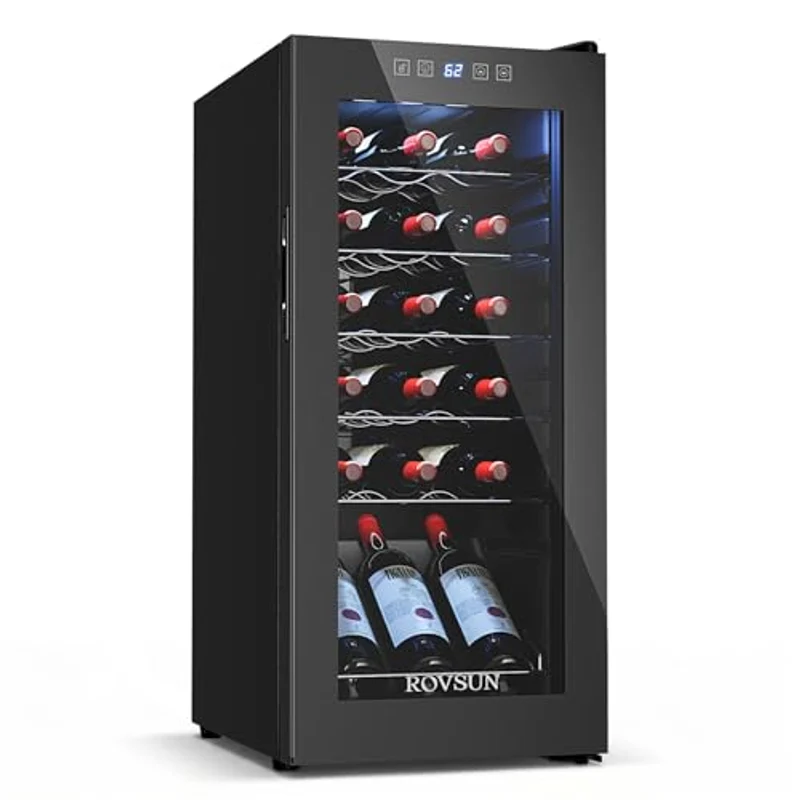
ROVSUN 18 Bottle Freestanding Compressor

The cheap way to stop fighting the room

18 bottles·Single zone·Compressor·Freestanding

If your diagnosis was the 20°F ceiling in step one, this is the least expensive way out of it. Compressor cooling holds its setpoint regardless of what the kitchen is doing in August, which is the entire reason to move. You give up the silence — a compressor cycles and hums — and at this price the shelves are chrome wire rather than wood. It is freestanding, so it still needs air at the back and sides; do not solve one problem by creating the one in step two.

ROVSUN 18 Bottle freestanding compressor wine cooler
Price
$159.99
Check price →
02If you want to do it properly

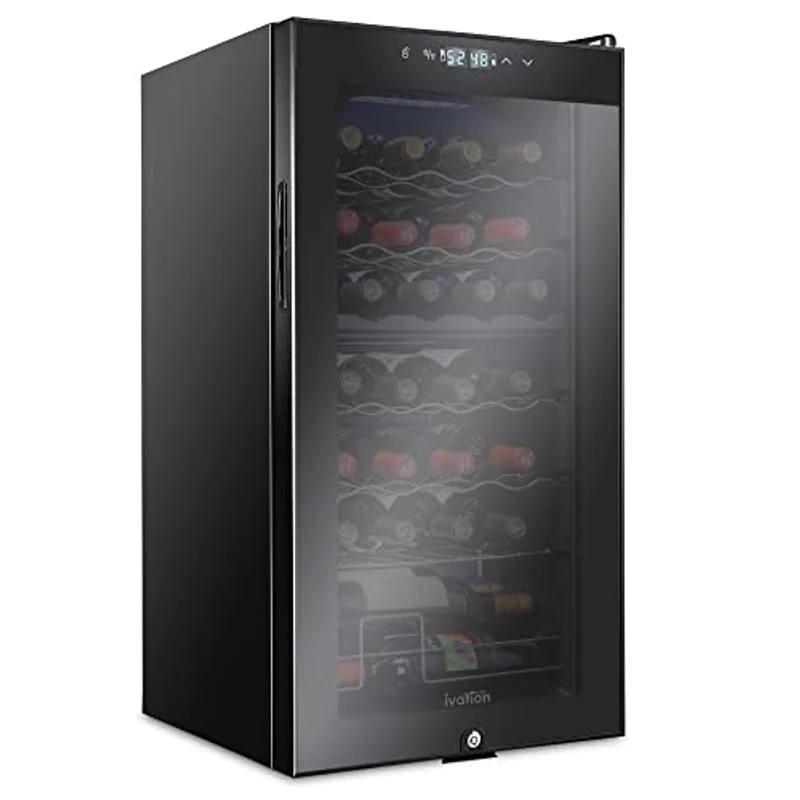
Ivation 28 Bottle Dual Zone Compressor

The replacement you will not be replacing again soon

28 bottles·Dual zone·Compressor·41–64°F · lock

Two independently controlled zones and a 41–64°F range, which is wide enough to run whites at serving temperature below and reds at true storage temperature above. Compressor cooling means the room stops being a variable. The lock is a genuine feature in a house with curious teenagers. It is freestanding — it needs breathing room at the back, and that is the one thing not to get wrong twice. If you are unsure whether the second zone earns its cost, we work through that decision here.

Ivation 28 Bottle dual zone compressor wine cooler
Price
$399.99
Check price →
03If it died in a cabinet

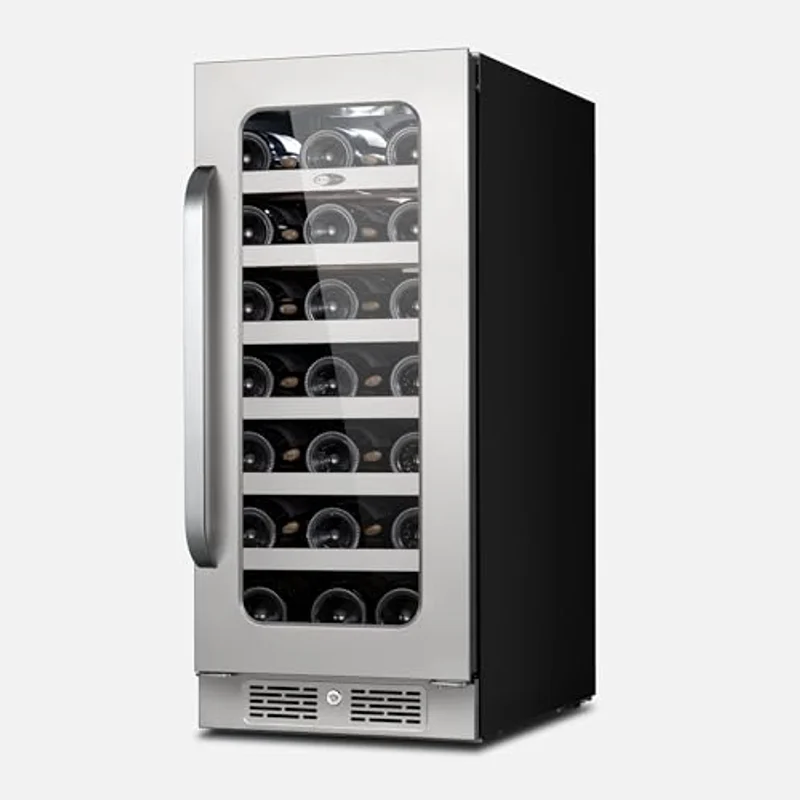
Whynter BSR-033SW 15″ Built-In Undercounter

The one you need if the old unit was enclosed

33 bottles·Single zone·Compressor·Front-venting

If your unit failed because a freestanding model was built into a cabinet run, this is the specification that fixes the actual cause. It vents through the front grille, Whynter rates it for built-in installation, and it fits the standard 15-inch cabinet opening. Thirty-three bottles in that width is an efficient use of the space, and single zone is the right call here — splitting a 15-inch cabinet in two leaves both halves too small to be much use. Keep the front grille clear and it will not repeat the old unit’s history.

Whynter BSR-033SW 15 inch built-in undercounter wine refrigerator
Price
$499.99
Check price →

If the budget has to stay tight, read what $200 actually buys in a small wine fridge first — the compromises at that price are predictable, and knowing where they land is the difference between a good cheap unit and a repeat of this page. The full comparison of the six wine fridges we recommend covers the rest of the range.

FAQ

Questions owners keep asking

Why is my wine fridge running constantly but not getting cold?

Almost always because the heat it removes cannot escape. Check clearance first: a freestanding unit needs several inches of open air at the back and sides, and a built-in needs an unobstructed front grille. Then clean the condenser coils with the unit unplugged. Then check the door seal — a gasket that leaks makes the compressor run permanently while the cabinet stays warm. If all three are clean and it still runs without ever reaching setpoint, a refrigerant leak becomes the likely explanation, and that is a technician’s job.

How long should a wine fridge take to cool down?

An empty cabinet typically needs four to twelve hours to reach its setpoint from room temperature. A cabinet you have just filled with room-temperature bottles needs around 24 hours, sometimes longer, because each bottle is a pound and a half of liquid that has to be cooled too. Wine coolers deliberately cool gently to avoid drying corks, so do not judge one in the first few hours.

Can I add refrigerant to my wine cooler myself?

No. Household wine coolers are sealed systems with no service port, they are not designed to be recharged, and in the United States venting refrigerant is illegal — handling it requires EPA Section 608 certification. The automotive recharge kits sold in hardware stores are not compatible with this equipment and using one risks injury and the destruction of the appliance. If the sealed system has failed, either the warranty covers it or you decide between a certified technician and a replacement.

My wine fridge only cools to about 20 degrees below the room. Is it broken?

Probably not — that is the normal limit of a thermoelectric unit. Peltier cooling can only pull roughly 20°F below ambient, so the same cooler that holds 52°F in a 72°F room will only manage 65°F in an 85°F room. Measure the room and the cabinet at the same time: if the gap is stable near 20°F, nothing has failed. Cool the room, move the unit, or switch to a compressor model.

Is it worth repairing a wine fridge that has stopped cooling?

It depends on the price of the unit and the warranty. A service call plus diagnosis commonly runs $100 to $200 before parts, and a sealed-system repair adds several hundred more, so on a unit under about $400 replacement usually wins. Check the warranty first, though: the sealed system typically carries a longer term than the rest of the cabinet, and a compressor failure inside that window may be covered entirely.

Should the top shelf be warmer than the bottom?

Slightly, yes. Warm air rises, so any tall single-zone cabinet has a gradient of a few degrees from bottom to top, and some owners use it deliberately by keeping whites low. A difference of ten degrees or more is not normal and points at a blocked rear vent, a failed internal fan, or a door seal leaking at a top corner.

Keep reading

If this changed your diagnosis

Every guide on the site is listed in the full library, and the current recommendations live on the home page.