Reader-supported: we may earn a commission if you buy through the links on this page, at no extra cost to you. It never changes which product we recommend. Prices below were correct at the time of writing and move often — confirm on Amazon before you buy.
Wine coolers get sold on the things you can see: the capacity, the finish of the door, the colour of the interior light. The thing that actually decides whether the appliance does its job is invisible from the product photo. It is the cooling system behind the back panel, and there are only two of them on the consumer market.
A thermoelectric cooler has no compressor and no refrigerant. A compressor cooler is a small refrigerator, built from the same components as the one in your kitchen. They are not two grades of the same thing, one cheap and one expensive. They are two different machines with two different failure modes, and the honest comparison is not which one wins — it is which one is wrong for your situation.
The single question that settles it is not about wine at all. It is: which room is this going in, and how hot does that room get in August? Everything below is really just an unpacking of that question.
- How each one actually cools
- The 20°F rule that decides everything
- Noise, vibration and where they matter
- Capacity and how fast it pulls down
- Energy use — and a myth
- Reliability, lifespan and repair
- The two systems side by side
- The decision rule, plainly
- Which specific unit to buy
- Questions people actually ask
How each one actually cools
Thermoelectric: a solid-state heat pump
A thermoelectric cooler is built around a Peltier module — a wafer of semiconductor junctions sandwiched between two ceramic plates. Run direct current through it and something slightly strange happens: one face gets cold, the other gets hot. Nothing moves, nothing boils, nothing circulates. The electricity itself is doing the pumping of heat from one side of the wafer to the other.
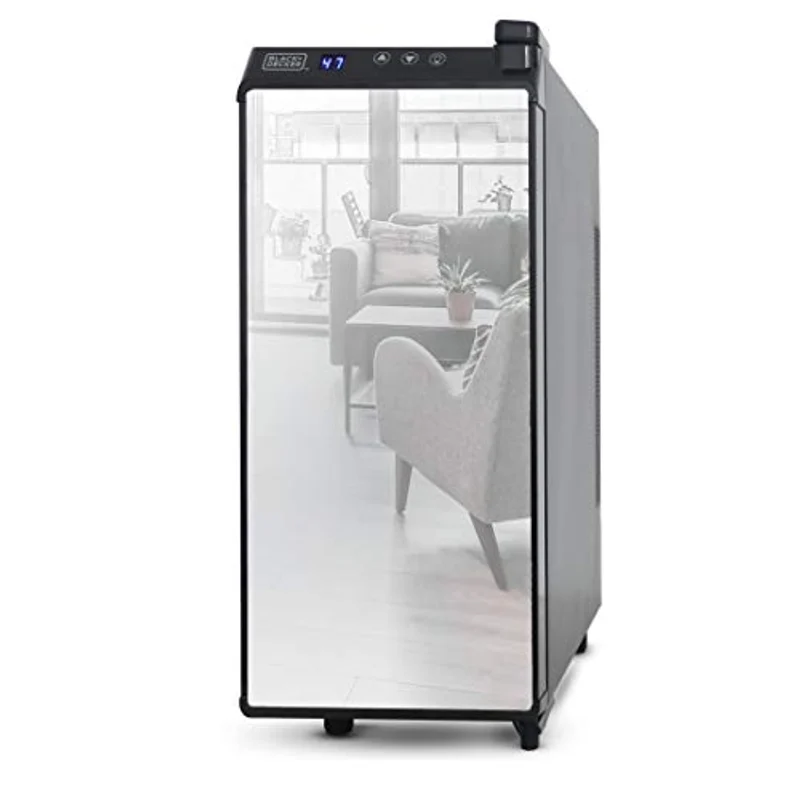
Inside a wine cooler, the cold face points into the cabinet and the hot face is bonded to a finned aluminium heatsink on the back, where a small fan blows the heat away into the room. That is the entire cooling system: a wafer, two heatsinks, a fan or two and a power supply. No refrigerant, no oil, no sealed loop, no moving compressor — which is why these units are so quiet and so light. The BLACK+DECKER BD60336 here weighs 28.3 pounds with a mirrored glass door and occupies roughly a 10-inch by 20.4-inch footprint.
Compressor: the same cycle as your kitchen fridge
A compressor cooler runs the vapour-compression cycle, the same one used by every domestic refrigerator, air conditioner and freezer built in the last century. A compressor squeezes refrigerant gas until it is hot and high-pressure; the condenser coil on the back sheds that heat into the room; the refrigerant passes through an expansion device, drops in pressure and turns very cold; the evaporator coil inside the cabinet absorbs heat from the air and the wine; the gas returns to the compressor and goes around again.
The important structural difference is not the parts list. It is that this cycle does not care what the room is doing. Raising the temperature of the room means the condenser sheds heat a little less easily, so the compressor runs a bit longer per cycle and draws a bit more power. But the cold side still gets as cold as it needs to. A vapour-compression fridge in an 85°F garage will still reach 40°F inside. It simply works harder to do it.
The 20°F rule that decides everything
Here is the fact that ought to be printed on the front of every thermoelectric wine cooler box, and never is.
Thermoelectric cooling is relative, not absolute. A Peltier module can only pull the cabinet interior to roughly 20°F below the temperature of the room it is standing in. That number is not a setpoint the unit chooses. It is a physical ceiling on what the module can achieve, and no control panel can override it.
Compressor cooling is absolute. You set 55°F and the machine holds 55°F, in a 68°F dining room or an 88°F sunroom, until something breaks.
Work through what the 20°F ceiling means in an actual American house, because this is where the disappointment comes from.
- A 68°F room — a climate-controlled interior room, a basement, a north-facing study. The unit can reach about 48°F. Comfortably below the 55°F storage standard, with room to spare. It works beautifully.
- A 72°F room — a normal thermostat setting. The unit reaches about 52°F. Still fine, still below 55°F, still doing real wine storage.
- A 78°F room — a kitchen in July with the oven on, or a house where the air conditioning is set economically. The unit reaches about 58°F. Marginal. Above the storage standard, though not catastrophic for a bottle you plan to drink this month.
- An 85°F room — an August kitchen, a sunroom, an unconditioned apartment, a garage almost anywhere south of Chicago. The unit reaches about 65°F. That is not wine storage. That is a slightly cool cupboard, and it will age a bottle noticeably faster than 55°F would.
Note what does not happen in the last case. The unit does not throw an error, flash a warning or shut down. It sets its digital display to whatever number you asked for, runs its fan continuously, and simply never gets there. The theme that repeats across owner reviews of thermoelectric coolers is exactly this: the complaints cluster in summer, from people in warm rooms, and they read as a product defect when they are actually the technology working exactly as designed at the edge of its envelope. A great many of the units returned as broken were never broken. If that is where you are right now, our not-cooling checklist walks through how to tell the difference before you replace anything.
There is a second-order effect worth knowing. A Peltier module's efficiency falls off as the temperature difference across it grows. So a thermoelectric unit fighting a hot room is not just failing to reach the setpoint; it is doing that failing at its least efficient operating point, running flat out, drawing power continuously, and producing more heat out of the back into the room it is already losing to.
Compressor units have their own ambient limits, but they are much further out. Most wine coolers, including the ones here, publish an operating range that comfortably covers a normal house; you set a target inside the unit's stated range — 41 to 64°F on the Ivation 28 Bottle, 40 to 65°F on the Whynter 100 Bottle — and it holds it. If you want the reasoning behind which number to set, we cover that in the wine fridge temperature guide; the short version is that stability matters more than hitting a perfect figure.
Noise, vibration and where they matter
This is the column where thermoelectric wins, and it wins convincingly rather than marginally.
Noise
A thermoelectric cooler has no compressor to start, run and stop. What you hear is a small fan, at a constant low level, with no cycling. It is the sound of a laptop idling in the next room. Because there is no start-up, there is no moment where the appliance announces itself — and it is the announcing that wakes people, not the average level.
A compressor unit is different in kind, not just in volume. It sits silent, then the compressor kicks in with a small mechanical clunk, hums for some minutes, and shuts off with another. In a kitchen you will never notice. At 2am in a studio apartment where the fridge is nine feet from the pillow, the clunk is the entire problem.
We are not going to publish a decibel figure for any specific model on this page, because we do not have measured data for these units and neither does anyone else quoting numbers at you. As a rough category guide only: thermoelectric wine coolers generally sit in the low-to-mid 20s to low 30s dBA range, and compressor units in the high 30s to mid 40s dBA when the compressor is running. Treat those as approximate category bands, not specifications. Manufacturer noise claims in this category are famously optimistic and are typically measured under conditions nobody has described.
One honest warning about marketing language: "quiet compressor", "low-noise compressor" and "whisper compressor" all mean the same thing, which is that it makes noise. It is a compressor. Nothing in the price range covered here is silent. If silence is a hard requirement, thermoelectric is the only technology that delivers it, and you accept the ambient ceiling as the price.
Vibration
Vibration is the less obvious half, and for anyone actually ageing bottles it may be the more interesting one. A compressor is a motor with a reciprocating piston bolted to a cabinet. It transmits a low-frequency buzz through the chassis into the shelves and into every bottle sitting on them. A thermoelectric unit has nothing that reciprocates. The only moving parts are fan blades on bearings, and the vibration they produce is effectively nil at the shelf.
Whether that matters depends entirely on your time horizon, and we should be careful not to oversell it. For bottles you will drink within a year or two, vibration is not going to be what ruins them — temperature swings will get there first. For bottles you intend to lay down for five or ten years, continuous low-frequency vibration is a genuine consideration: it keeps the fine sediment in an older red in suspension rather than letting it settle, which is why serious cellars are built to be still. It is also why the near-total stillness of a thermoelectric unit is a real advantage for a small collection of ageing bottles in a cool interior room — the one scenario where thermoelectric is not the compromise choice but the better one.
Capacity and how fast it pulls down
Thermoelectric cooling does not scale. You can add Peltier modules to a bigger cabinet, but each one is inefficient, each one needs its own heatsink and fan, and each one draws meaningful power. Past a certain size the arithmetic collapses, which is why thermoelectric units in the retail market are overwhelmingly 6 to 20 bottles and why nobody sells a 100-bottle thermoelectric cabinet. The three thermoelectric units in this comparison are 6, 12 and 12 bottles. That is the shape of the whole category.
Compressor cooling scales as far as you want to pay for. The units here run from 12 bottles to 100. Above roughly 40 bottles a second specification becomes important: fan-forced internal circulation. A tall cabinet without it stratifies, and the top shelf can sit several degrees warmer than the bottom. The Whynter BWR-1002SD calls out fan-forced circulation for exactly this reason, and at 100 bottles it is not a luxury.
Pull-down speed follows the same pattern. Load six room-temperature bottles into a thermoelectric cooler and it will take many hours, sometimes the better part of a day, to bring the cabinet back to target — the module can only move so much heat per hour, and warm bottles are a lot of thermal mass. A compressor unit of similar size pulls down substantially faster, and recovers faster after the door has been open. If you buy wine on the way home and want it at serving temperature that evening, that difference is one you will feel every week.
Installation is a separate axis, and worth flagging because people conflate the two: every unit named on this page is freestanding, meaning it rejects heat from the back and sides and must not be sealed into a cabinet run. That applies to the thermoelectric models too — a Peltier heatsink starved of airflow fails just as surely as a smothered condenser. We cover that trap in detail in built-in versus freestanding, and it is the most expensive mistake in the category.
Energy use — and a myth
Thermoelectric units are widely assumed to be the greener, cheaper-to-run option because they are small and have no compressor. In a fair comparison, that assumption is frequently wrong.
Peltier modules are thermodynamically inefficient. Their coefficient of performance — heat moved per unit of electricity consumed — is poor compared with a vapour-compression cycle, and it degrades further as the temperature difference across the module increases. A compressor is comparatively efficient, and crucially it cycles: once it reaches the setpoint it shuts off entirely and draws almost nothing until the cabinet drifts.
Put those together and you get the case that actually matters. In a warm room, a thermoelectric unit chasing a setpoint it can never reach never switches off. It runs continuously, at its least efficient operating point, twenty-four hours a day, and still does not get there. The compressor unit next to it reaches its number, stops, and idles. The unit that is theoretically more frugal ends up consuming more, and the one drawing more power is the one actually storing your wine correctly.
In a cool room the picture reverses and the small thermoelectric unit is genuinely modest, because it only has a few degrees of work to do and it is a small box. The honest summary: at small sizes in cool rooms, thermoelectric is cheap to run; anywhere warm, the efficiency argument for thermoelectric is not just weaker, it is backwards. We are not going to put a dollar figure on that here, because it depends on your room temperature, your utility rate and how often the door opens, and any number we invented would be a number you should not trust.
Reliability, lifespan and repair
Fewer moving parts is a real advantage and it is often overstated. Here is the balanced version.
Thermoelectric. The Peltier module itself has no wearing parts and can run for a very long time. What fails, in practice, is everything around it: the fans wear out their bearings, the thermal paste between the module and the heatsink dries and its conductivity drops, dust cakes the fins and the whole assembly loses its ability to dump heat. The failure mode is usually gradual rather than sudden — the unit simply stops holding the temperature it used to. The upside is that fans and thermal paste are cheap, and a mildly handy owner can restore a unit with a can of compressed air, a new fan and a syringe of paste. There is no sealed refrigerant circuit to violate.
Compressor. A sealed vapour-compression system is a mature, well-understood piece of engineering, and when it is left alone it lasts a long time — this is the same technology that runs kitchen refrigerators for fifteen years. But its failures are binary and expensive. A refrigerant leak or a dead compressor on a $160 wine cooler is not economically repairable; a sealed-system repair requires a certified technician and costs more than the appliance. Compressors also have installation requirements that thermoelectric units do not: keep it upright in transport, and if it has been laid on its side, let it stand for several hours before powering it on so the oil drains back out of the lines. Ignoring that is a genuine, common way to kill a new unit on day one.
Neither technology is fragile when it is used inside its envelope. Most of what gets reported as premature failure in this category is an installation or ambient-temperature problem wearing the costume of a hardware fault.
The two systems side by side
| What matters | Thermoelectric | Compressor |
|---|---|---|
| How it cools | Peltier module, solid state, no refrigerant | Vapour-compression cycle, sealed refrigerant loop |
| Coldest it can get | About 20°F below the room, whatever the room is | Its stated setpoint range, largely independent of the room |
| In an 85°F kitchen | Reaches about 65°F. Not wine storage. | Holds 55°F. Runs longer to do it. |
| Noise | A constant faint fan. No cycling, nothing to startle you. | Cycles on and off with an audible hum and a click. |
| Vibration | Effectively none | Low-frequency buzz through shelves and bottles |
| Practical capacity | 6–20 bottles. The technology does not scale. | 12 to 100+ bottles |
| Pull-down speed | Slow; many hours after a warm load | Considerably faster, recovers quickly after the door opens |
| Energy | Modest in a cool room; poor in a warm one, where it never cycles off | Cycles off at setpoint; efficient relative to the work done |
| Typical failure | Gradual: fans, dust, dried thermal paste. Often owner-fixable. | Binary: sealed-system fault. Rarely worth repairing under $400. |
| Belongs in | Bedroom, home office, study, cool basement, dorm | Kitchen, dining room, bar, garage, anywhere warm |
The decision rule, plainly
Forget the comparison table for a second. Answer one question honestly: how hot does the room get on the hottest week of the year, when nobody is home to run the air conditioning?
- If the answer is reliably 75°F or below — and it stays there in August — thermoelectric is not a compromise. It is genuinely the better appliance for that room: silent, still, and perfectly capable of the 55°F you need. Buy it and enjoy the quiet.
- If the answer is above 78°F, or you do not know — buy a compressor unit. There is no configuration, no setting and no premium thermoelectric model that gets around the physics. A room you cannot vouch for should be treated as a warm room.
- If it is a bedroom, a nursery-adjacent wall or a home office where you take calls — and the room stays cool — thermoelectric, for the noise and vibration alone.
- If it is a garage, a sunroom, a conservatory or a west-facing kitchen — compressor, without hesitation, and check the model's stated ambient operating range before buying.
- If you want more than 20 bottles — the decision is already made for you. Compressor is the only option that exists at that size.
There is one more variable that quietly overrides all of this: money. Compressor cooling now starts at around $130, which is the same money as a mid-range thermoelectric unit. Ten years ago the thermoelectric argument was partly a budget argument. It is not any more. If you were choosing thermoelectric to save money rather than to buy silence, that reason has expired.
And if you are still weighing zones on top of cooling type, the two decisions are independent — work through dual zone versus single zone after you have settled this one, not before. Cooling type is the decision that cannot be undone by a setting.
Which specific unit to buy
Seven units, split by technology. Prices were correct at the time of writing.
If your room stays cool: thermoelectric
BLACK+DECKER BD60336 12-Bottle
The best-balanced thermoelectric unit here
Twelve bottles is about the practical ceiling for the technology, and this is the size where it makes the most sense: a mirrored glass door, a roughly 10-inch by 20.4-inch footprint that will sit on a counter or a sideboard without dominating it, and 28.3 pounds of appliance you can move by yourself. In a room held at 72°F it will reach the low 50s and hold there in silence. In a room that hits 85°F it will not, and no amount of setting the panel lower will change that. Buy it for the room, not for the spec sheet.
The right buy for a study, a bedroom or a cool basement — and the wrong one for a summer kitchen.
BLACK+DECKER BD60016 6-Bottle
The smallest sensible version of the idea
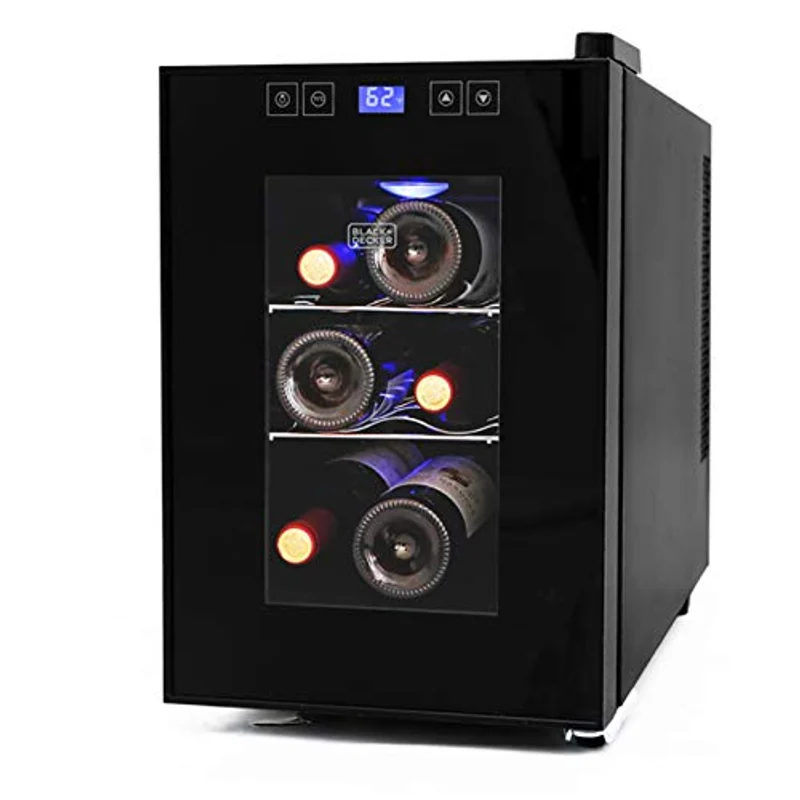
Six bottles is a working set, not a collection: the two whites you are drinking this week and a few reds waiting their turn. At this size the thermoelectric argument is at its strongest — the cabinet is small enough that the module has an easy job, it draws very little, and it is silent enough to sit on a desk. It is also the cheapest honest entry point into temperature-controlled storage. Just do not expect it to rescue a warm room; the same 20°F ceiling applies to a small box as to a large one.
A desk-side or bedside unit, and a good one, provided the room is cool.
Ivation 12 Bottle Thermoelectric
Countertop unit sized for reds and whites together
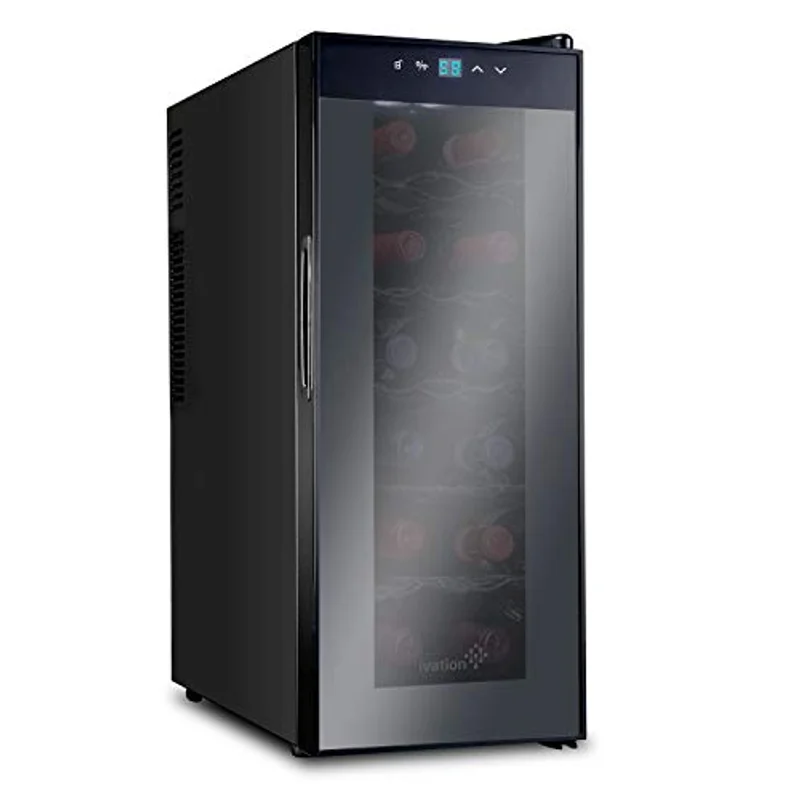
Ivation's countertop chiller is built for the household that keeps a few reds and a few whites at once and wants both within arm's reach, silently. It costs more than the BLACK+DECKER at the same twelve bottles, so it needs to earn that on styling and finish rather than on cooling — the underlying Peltier physics are identical, which means so is the ceiling. Reviewers consistently note the same pattern across every thermoelectric unit in this class: excellent in a temperate room, disappointing in a hot one.
Choose it over the BLACK+DECKER on looks and layout, not on performance. They face the same wall.
If the room gets warm, or you want more than 20 bottles: compressor
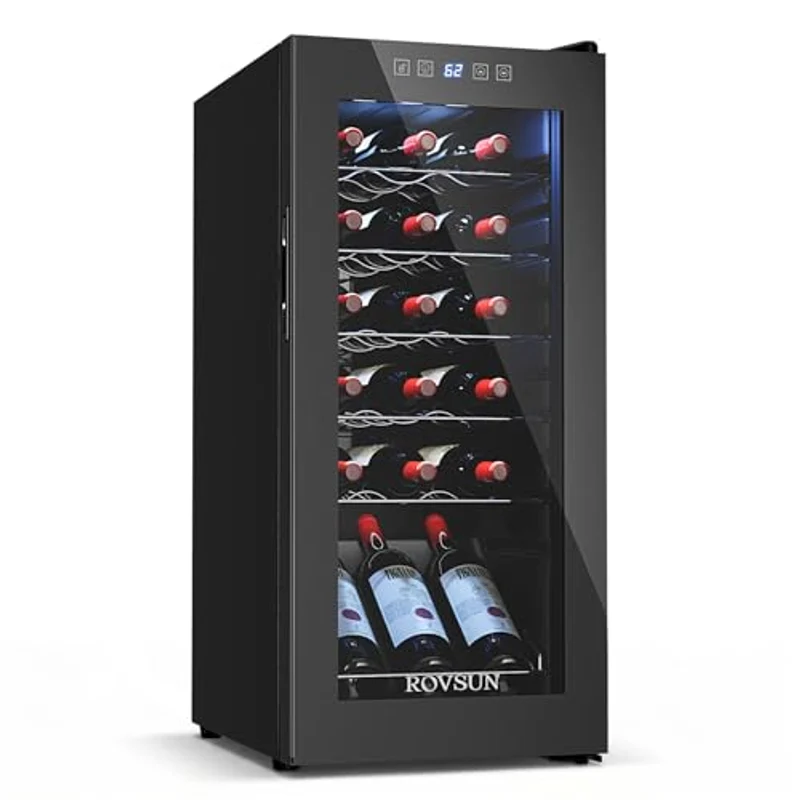
ROVSUN 18 Bottle Freestanding
The cheapest way out of the ambient trap
This is the single most useful product on the page, because of what it costs relative to what it solves. For the price of a mid-range thermoelectric unit you get real compressor cooling, digital temperature control and a double-layer glass door — and six more bottles. The trade is that you accept a hum you did not have to accept, and wire shelving rather than wood. If your room is anything other than reliably cool, this is the unit that turns the whole comparison from a dilemma into an easy call.
If you were about to buy a thermoelectric cooler for a kitchen, buy this instead.
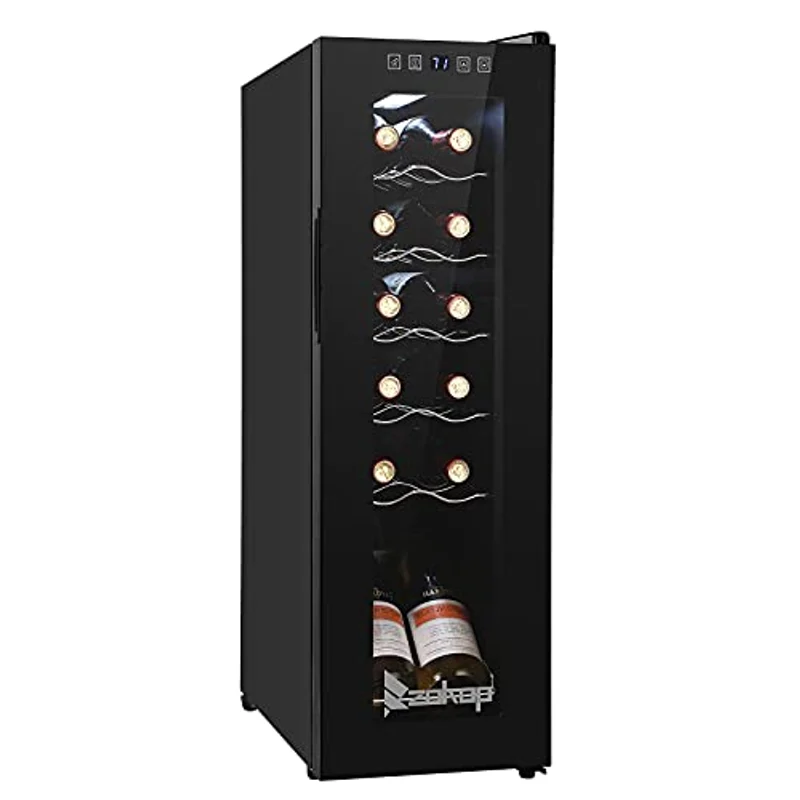
Winado 12 Bottle Compressor
Compressor cooling at thermoelectric money
The direct answer to the BLACK+DECKER 6-bottle: identical price, twice the bottles, and a cooling system that does not care how hot the kitchen gets. The catch is the one this entire article is about — it hums, and it transmits a little vibration into the shelves. That is the whole trade, stated as clearly as it can be stated. If you are shopping at the bottom of the market, our guide to small wine fridges under $200 puts this price bracket in context.
The cheapest unit here that will still hold 55°F in August.
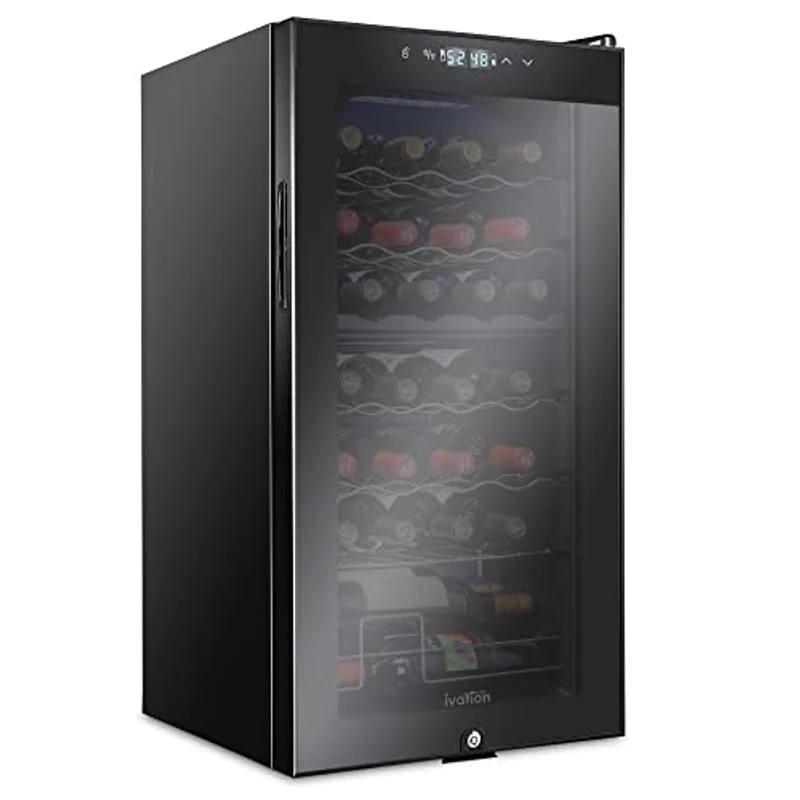
Ivation 28 Bottle Dual Zone
Where most people should land
Two independently set zones and a stated 41–64°F range, which is wide enough to run one side as a serving fridge for whites and the other as genuine 55°F storage for reds. It is freestanding, so it needs clear air behind it. The reason it belongs in this particular comparison is that it demonstrates the second half of the compressor argument: it is not only that compressors hold their setpoint, it is that they can hold two of them at once. No thermoelectric unit at any price does that in a meaningful way, because splitting an already limited cooling capacity in two makes a weak system weaker.
The point where the compressor's advantages stop being about survival and start being about control.
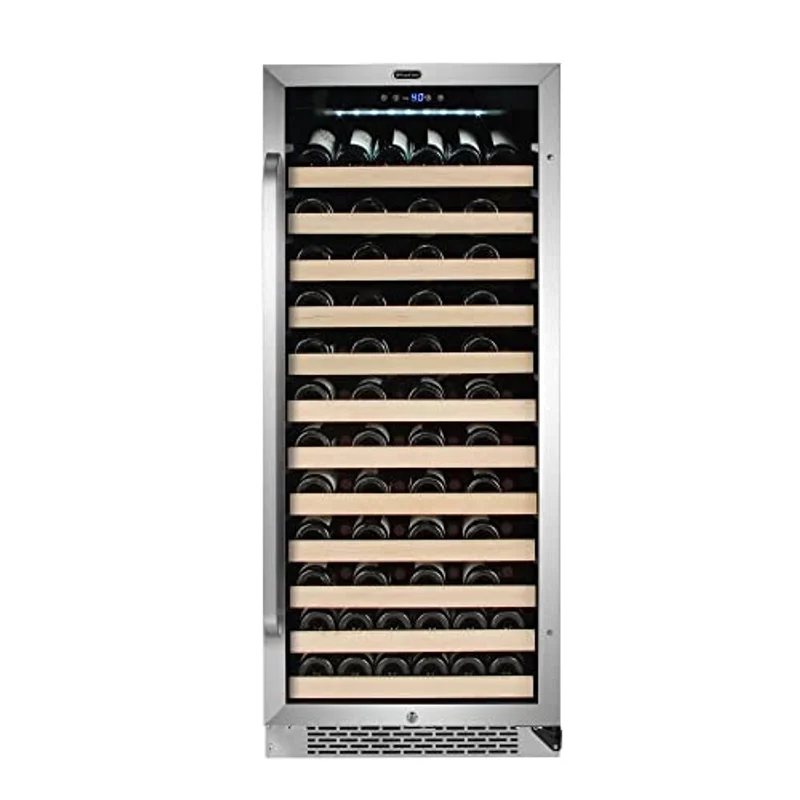
Whynter BWR-1002SD 100 Bottle
The size thermoelectric cannot reach
One hundred bottles, an adjustable 40–65°F range, and fan-forced internal circulation — which is the specification that matters most at this height, because a tall cabinet without forced air stratifies and the top shelf drifts warmer than the bottom. There is no thermoelectric equivalent of this appliance and there never will be; the technology simply does not scale to this volume. It is included here to close the argument: past about 20 bottles, the comparison in this article stops being a comparison.
At this size, cooling type is not a choice you get to make.
How we compared these, and what we cannot tell you
We compared published manufacturer specifications, current Amazon prices and the pattern in verified owner reviews, then reasoned from the physics of each cooling system about where the specifications are likely to hold and where they are likely to disappoint. We don't run a testing lab, we do not own these units, and we do not physically test them — anyone claiming long-term ownership of seven wine coolers across a range of room temperatures is describing a warehouse they do not have. We also publish no star ratings and no review counts on this site, because we will not repeat numbers we cannot stand behind, and we will not invent them. What we can do honestly is read the specifications carefully, track the prices, explain the mechanism, and tell you which trade you are actually making.
Questions people actually ask
Is a thermoelectric wine cooler ever the better choice?
Yes, and not as a consolation prize. In a room that reliably stays at or below about 72°F, a thermoelectric cooler reaches proper storage temperature, makes essentially no noise and transmits essentially no vibration into the bottles. For a small collection of ageing wine in a bedroom, a study or a cool basement, that stillness and silence make it the better appliance, not the cheaper one. The condition is the room, and the room is not negotiable.
My thermoelectric wine cooler will not get cold. Is it broken?
Probably not. Measure the temperature of the room it is standing in. A thermoelectric unit can only pull the cabinet to roughly 20°F below ambient, so a 78°F room caps it around 58°F and an 85°F room caps it around 65°F, no matter what the display says. Also check that there are several inches of clear air behind and above the heatsink, and that the fins are not caked with dust. If the room is cool, the vents are clear and it still will not hold temperature, work through our not-cooling checklist before replacing anything.
Is a compressor wine cooler too loud for a bedroom?
For most people, yes — not because of the running volume but because it cycles. The compressor starts with a small mechanical click, hums for some minutes and stops. It is the starting and stopping that wakes light sleepers, and no amount of "quiet compressor" marketing removes it. If a wine fridge is going within a few feet of a bed and the room stays cool, choose thermoelectric. If the room gets warm, put a compressor unit somewhere else in the house rather than compromising the wine.
Does a thermoelectric unit really use less electricity?
Only in a cool room. Peltier modules are thermodynamically inefficient, and their efficiency drops further as the temperature difference across them grows. In a warm room, a thermoelectric cooler never reaches its setpoint, so it never switches off — it runs continuously at its worst operating point. A compressor unit reaches its target and shuts down until the cabinet drifts. In that situation the compressor unit both uses less power and actually stores the wine correctly.
Can I put either type in the garage?
Only a compressor unit, and only after checking the manufacturer's stated ambient operating range. A garage swings far outside the envelope of thermoelectric cooling in both directions — too hot in summer to reach storage temperature, and cold enough in a northern winter that many coolers have no heating element to bring the cabinet back up. Compressor units handle heat well; check the low end of the range too if your winters are serious.
Keep reading
The three guides that follow on most naturally from this decision.
What Temperature Should a Wine Fridge Be?
You have chosen the cooling system. Now choose the number — and understand why holding it steady matters more than getting it exactly right. Read →
ComparisonDual Zone vs Single Zone Wine Fridges
The other decision that changes the shape of what you buy, and the honest test for whether your collection actually needs two zones. Read →
TroubleshootingWine Fridge Not Cooling?
Before you return a unit that is behaving exactly as designed: the checks that separate an ambient-temperature problem from a real fault. Read →
Start over from the beginning with our six best wine fridges of 2026, or browse every guide on the site.